

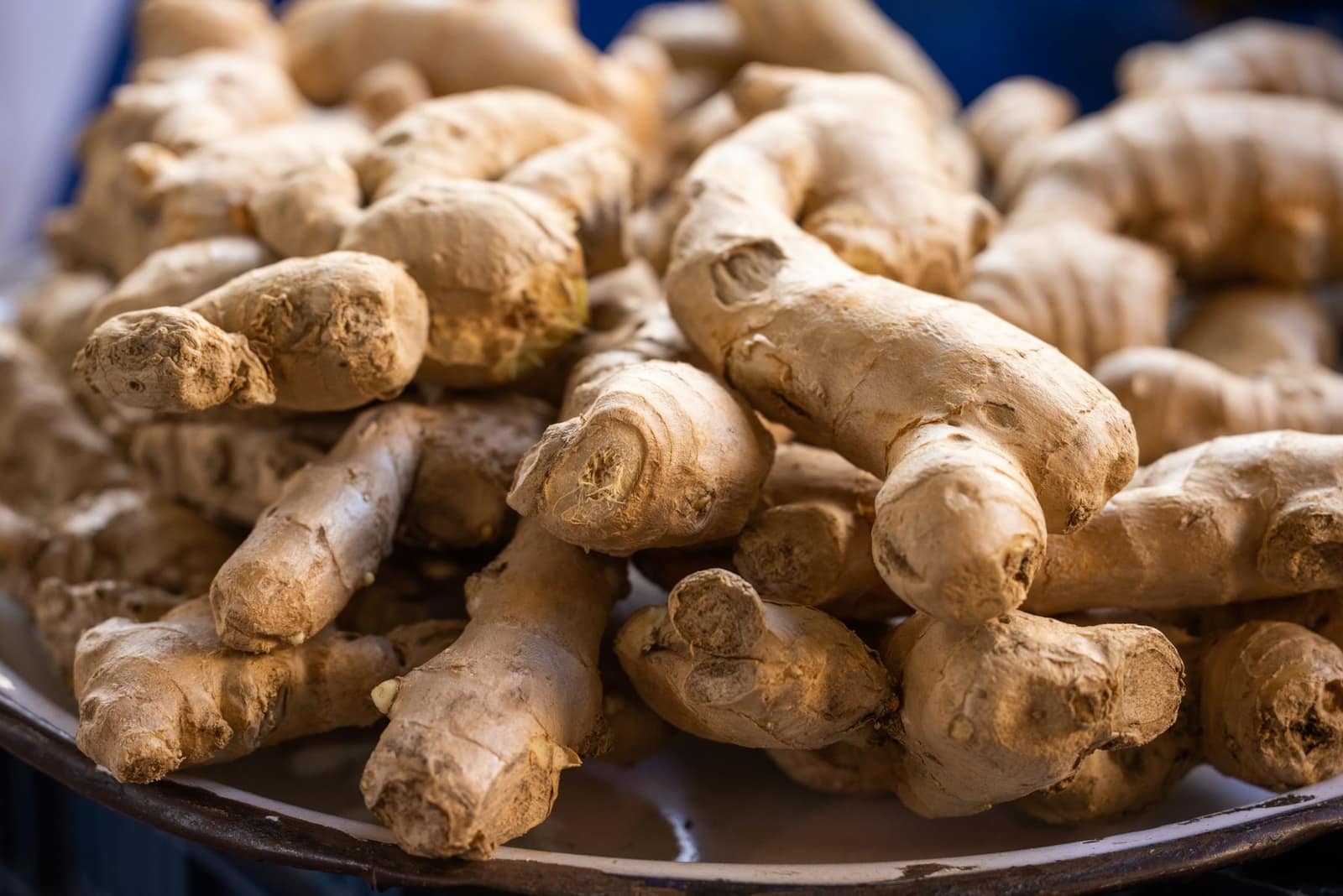
Farm produce
Export ginger
Fresh ginger to Bangladesh and the Gulf, dried and powdered ginger to Morocco, the USA and Europe. CRES needed.
- HS code
- 0910.11 Ginger neither crushed nor ground — fresh or dried (0910 11), and crushed or ground ginger (0910 12).
- Export policy
- Free to export Export is Free under ITC(HS), but ginger is a Spices Board spice — you need a CRES before exporting.
- Registrations
- 5 IEC, GST and those below
- India’s exports, 2025-26
- US$ 143 mn to 93 countries
What is exported
Ginger exports were about US$ 143 million in 2025-26 (TradeStat). Bangladesh is by far the biggest buyer of fresh ginger; Morocco, the USA, the UAE, Sudan, the UK and Germany buy mostly dried and ground ginger. India also has GI-tagged ginger from the North-East.
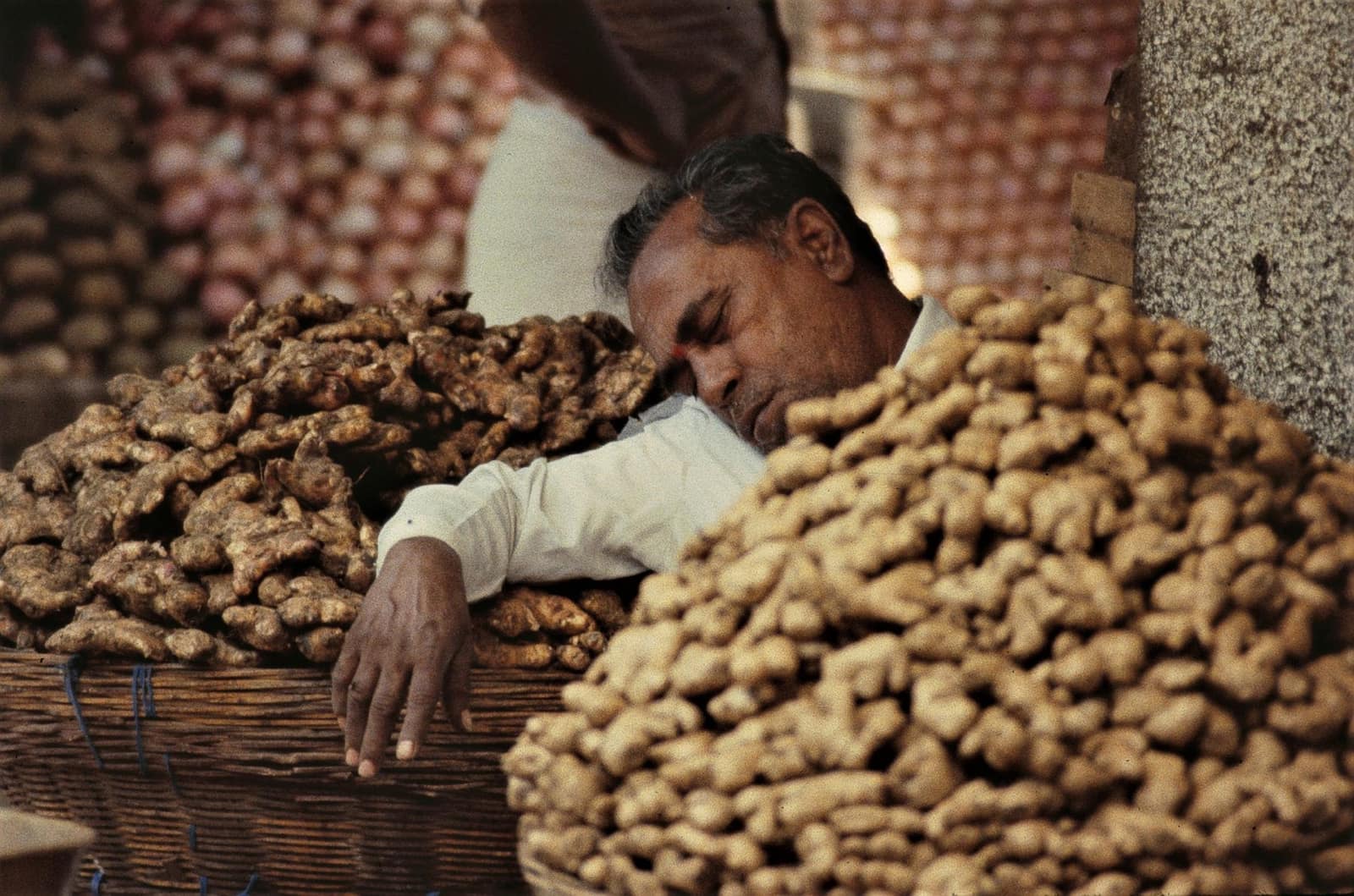
Varieties, grades and forms
- Fresh gingerWashed, cured rhizomes for Bangladesh, the Gulf and Europe.
- Dry ginger — Cochin and Calicut stylesPeeled or scraped and sun-dried; sold whole, sliced or split.
- Ginger powderGround from dry ginger; must be sterilised for most markets.
- North-East varieties (Nadia, low-fibre types)Low-fibre ginger from Meghalaya, Mizoram and Assam; several hold GI tags.
Where it is grown or made
- KeralaWayanad, Idukki, Ernakulam — dry ginger trade centred on Kochi.
- KarnatakaShivamogga, Hassan, Kodagu.
- North-EastKarbi Anglong (Assam), Mizoram, Meghalaya, Sikkim, Arunachal Pradesh.
- Odisha and West BengalFresh ginger moving to Bangladesh through land ports.
The quality buyers ask for
- Fresh ginger
- Washed, cured, plump hands of agreed weight; no soil, sprouting or rot
- Dry ginger
- Moisture, extraneous matter, mould and insect damage within AGMARK or buyer limits
- Contaminants
- Aflatoxin, Salmonella, ethylene oxide and residues to destination limits
Certificates
- Spices Board CRESRequiredCertificate of Registration as Exporter of Spices; required by law before exporting a listed spice.
- FSSAI licenceRequiredCentral licence from FSSAI for the premises where food is packed or stored for export.
- Phytosanitary certificateRequiredIssued by Plant Quarantine (DPPQS) for each consignment after inspection; apply on PQMS.
- HACCPOften askedFood-safety plan for the processing unit; most importers ask for it.
- Organic (NPOP / NOP / EU)Often askedOnly if sold as organic: NPOP certification from an accredited body plus the market’s own organic rules.
Shipping, storage and shelf life
Fresh: a 40-ft reefer typically about 25–27 tonnes in cartons; dry ginger: a 20-ft container typically about 12–15 tonnes in bags.
Road to Bangladesh; sea freight from Kochi, Chennai or JNPA for other markets.
Fresh ginger typically at about 12–14 °C; dry ginger in dry, pest-free godowns.
Fresh: weeks to a few months in reefers; dry: about a year if dry and sealed.
What goes on the pack and carton
- Bulk bags and cartons: product and grade, crop year, lot number, net and gross weight, "Product of India", exporter name and the buyer’s shipping marks, matching the invoice and packing list exactly.
- Lot or batch number on every pack and bag — required by FSSAI’s Labelling and Display Regulations, 2020, and used by every importing country to trace and recall.
- EU retail packs (Regulation 1169/2011): food name, ingredients with allergens highlighted, net quantity, best-before date, storage conditions, EU importer’s name and address, and origin where required — in the language of the country of sale.
- USA (21 CFR 101): product name, net quantity in US and metric units, ingredients, allergens, packer or distributor name and address, Nutrition Facts unless exempt, and "Product of India".
The Spices Board runs quality evaluation laboratories in Kochi, Mumbai, Chennai, Guntur, Narela (Delhi), Tuticorin, Kandla, Kolkata and Jodhpur (fees and forms on indianspices.com → Quality). NABL-accredited private labs are also used; check the Board’s list of mandatory tests for your spice and market.
Benefits of exporting this product
- RoDTEP refund on this line
Ginger neither crushed nor ground (0910 11) carries 0.9% of FOB; ginger powder (0910 12 10) carries 1%. No value cap. Rate as listed in Appendix 4R (w.e.f. 10 Oct 2024); DGFT Notification 41/2026-27 keeps the rates in force on 30 Sep 2026 unchanged until 31 Dec 2026. Check your exact 8-digit line on dgft.gov.in before you price.
DGFT — Appendix 4R, RoDTEP schedule for DTA exports w.e.f. 10 Oct 2024 (Notification No. 32, 30 Sep 2024) ↗ - GI tags
Registered ginger GIs: Assam Karbi Anglong Ginger, Mizo Ginger and Arunachal Pradesh Adi Kekir.
Spices Board — List of GI tags registered for spices (as of 15 Sep 2026) ↗ - Spices Board SPICED scheme
The Spices Board supports registered exporters under its SPICED scheme (quality upgrades, testing, market promotion). Applications for 2026-27 opened online on 1 July 2026; watch the Board’s scheme page for the next call.
Spices Board — SPICED scheme programmes for 2026-27 ↗
Where to register
- Spices BoardCertificate of Registration as Exporter of Spices (CRES). Required by law for anyone exporting a spice listed by the Spices Board, and it also serves as your RCMC.indianspices.org.in ↗
- FSSAIFood business licence. FSSAI puts food exporters under the Central licence; apply on FoSCoS for the premises you pack from.foscos.fssai.gov.in ↗
- Plant Quarantine (DPPQS)Phytosanitary certificate for each consignment of plant produce, applied for online on PQMS. Some markets also want the packhouse or processing unit registered.pqms.cgg.gov.in ↗
Quality and checks
- Ethylene oxide must not be used. The EU limit is 0.1 mg/kg on most spices and 0.02 mg/kg on curry powder, masala mixes and chilli (Spices Board SPS list); steam-sterilise instead.
- Salmonella must be absent in 25 g for the EU and Australia; buyers also check moisture, extraneous matter and mould.
- Pesticide residues must meet the destination country’s MRLs; check them in APEDA’s International Pesticide MRL Database before you buy the crop.
- Fresh ginger must be washed, soil-free and well cured; plant quarantine services reject soil and rhizome rot.
- Test each lot at an NABL-accredited or board laboratory before shipment and keep the report with the lot number.
Fresh ginger to Bangladesh needs fast land-port logistics; dried ginger is easier for a beginner. Get a CRES and send 1–5 tonnes of tested dried ginger slices or powder to a spice importer in the Gulf, UK or USA. Since 15 September 2026, a consignment worth up to ₹3 lakh FOB does not need an RCMC (DGFT Notification 36/2026-27); registrations required by a law still apply.
Where new exporters go wrong
- Mould and aflatoxin in dried ginger dried on open ground — dry on clean platforms or in dryers.
- Fresh ginger with soil or rot — whole consignments get rejected at destination quarantine.
Documents this product needs
Schemes that apply
- RoDTEP Remission of Duties and Taxes on Exported Products
- Drawback Duty Drawback (All Industry Rates)
- LUT Letter of Undertaking for zero-rated exports under GST
- ECGC ECGC export credit insurance for small exporters
- Districts as Export Hubs Districts as Export Hubs
- EPM Export Promotion Mission (Niryat Protsahan and Niryat Disha)
- MAI / MAS Market Access Initiative (now Market Access Support under EPM)
Sources (5)
- Department of Commerce — TradeStat, India’s exports by commodity and country (2025-26)
- Spices Board — Major item/country-wise export of spices (2021-22 to 2025-26)
- Spices Board — SPS requirements for spices (risks reported in export consignments)
- Spices Board — List of GI tags registered for spices (as of 15 Sep 2026)
- DGFT Notification 36/2026-27 (15 Sep 2026) — no RCMC needed for consignments up to ₹3 lakh FOB
Trade data
Indian ginger exports in numbers
From the Department of Commerce’s TradeStat, country by country. US$, Indian financial years (April–March).
- Exports in 2025-26
- US$ 143 mn +4.4% a year on average, 2020-21 to 2025-26
- Change from 2024-25
- ↑ +14.3% US$ 125 mn → US$ 143 mn
- Buyer countries
- 93
- Average export price
- US$ 0.98 per kg · 1,46,257 tonnes shipped · US$ 0.95 the year before
The price cycle
India’s average export price per kg each year (total value ÷ total quantity). Highest in 2022-23, lowest in 2021-22 — a 40% swing between them. Keep this swing in mind when you quote.
What next: a projection from the trend
The past trend carried forward — not a forecast by any authority. Sudden changes in policy, prices or demand are not in it.
Likely range US$ 69 mn to US$ 226 mn.
- Trend
- +5.2% a year
- Fit (R²)
- 0.07 — weak, read with care
- Based on
- 6 years of official figures
Method: a straight line through the logarithm of yearly exports (log-linear regression); range = ±1 standard error.
Biggest buyer countries
By value in 2025-26. Change is against 2024-25.
Where demand is rising and falling
Only countries that buy at least US$ 1 million or 1% of India’s exports of this product. Change from 2024-25 to 2025-26.
↑ High demand
- SudanUS$ 1.7 mn → US$ 5.2 mn↑+204.7%
- South AfricaUS$ 1.7 mn → US$ 2.8 mn↑+63.3%
- EgyptUS$ 1.8 mn → US$ 2.7 mn↑+52.8%
- MoroccoUS$ 17 mn → US$ 24.2 mn↑+42.3%
- GermanyUS$ 2.1 mn → US$ 2.9 mn↑+39.5%
- NetherlandsUS$ 1.6 mn → US$ 2.1 mn↑+25%
- CanadaUS$ 1.3 mn → US$ 1.6 mn↑+21.4%
↓ Low demand
- Saudi ArabiaUS$ 4.4 mn → US$ 1.9 mn↓-57.9%
- United Arab EmiratesUS$ 13.7 mn → US$ 10.7 mn↓-22.4%
- YemenUS$ 1.9 mn → US$ 1.5 mn↓-19.6%
Which forms sell, and at what price
India’s exports by 8-digit tariff line, 2025-26. Average price = total value ÷ total quantity (TradeStat): the average of every shipment on that line, not the price of any one deal.
| Tariff line | Value 2025-26 | Change | Quantity | Average price |
|---|---|---|---|---|
Spices, ginger, neither crushed nor ground — fresh0910 11 10 | US$ 53.1 mn | ↑+9.5% | 1,15,873 tonnes | US$ 0.46 per kgwas US$ 0.45 |
Spices, ginger, neither crushed nor ground — dried, unbleached0910 11 20 | US$ 43.4 mn | ↑+16% | 16,102 tonnes | US$ 2.70 per kgwas US$ 3.01 |
Spices, ginger, crushed or ground — powder0910 12 10 | US$ 21.9 mn | ↑+13% | 6,325 tonnes | US$ 3.46 per kgwas US$ 3.57 |
Spices, ginger, neither crushed nor ground — dried, bleached0910 11 30 | US$ 10.7 mn | ↑+59.2% | 3,856 tonnes | US$ 2.76 per kgwas US$ 3.15 |
Other ginger; neither crushed nor ground0910 11 90 · Spices, ginger, neither crushed nor ground | US$ 7.6 mn | ↑+15.9% | 2,775 tonnes | US$ 2.73 per kgwas US$ 2.31 |
Other ginger; crushed or ground0910 12 90 · Spices, ginger, crushed or ground | US$ 6.4 mn | ↓-3% | 1,326 tonnes | US$ 4.82 per kgwas US$ 4.69 |
The world market
Each country’s own recorded exports and imports in UN Comtrade, 2023 (the latest year nearly every country has reported).
- World imports
- US$ 1.23 bn 2023
- India among exporters
- #6 of 124 countries
- India’s share of world exports
- 4.8% US$ 65.1 mn
- Left for others to win
- US$ 1.29 bn exported by other countries
Top exporters — your competitors
- 1ChinaUS$ 582 mn 42.8%
- 2NetherlandsUS$ 129 mn 9.5%
- 3PeruUS$ 120 mn 8.9%
- 4ThailandUS$ 76.8 mn 5.7%
- 5BrazilUS$ 66.1 mn 4.9%
- 6IndiaUS$ 65.1 mn 4.8%
- 7NigeriaUS$ 47.6 mn 3.5%
- 8United Arab EmiratesUS$ 47.3 mn 3.5%
- 9GermanyUS$ 34.6 mn 2.5%
- 10IndonesiaUS$ 28.4 mn 2.1%
Biggest buyers in the world
- 1USAUS$ 160 mn 13%
- 2NetherlandsUS$ 144 mn 11.7%
- 3GermanyUS$ 110 mn 8.9%
- 4JapanUS$ 106 mn 8.7%
- 5United KingdomUS$ 65.6 mn 5.3%
- 6MalaysiaUS$ 57.3 mn 4.7%
- 7CanadaUS$ 53.7 mn 4.4%
- 8United Arab EmiratesUS$ 43.4 mn 3.5%
- 9PakistanUS$ 42.9 mn 3.5%
- 10Saudi ArabiaUS$ 39.3 mn 3.2%
Opportunity: what these countries buy from the world, and from India
Each country’s own recorded imports in UN Comtrade, latest year it has reported. The long light part of each bar is demand other countries are filling today.
TradeStat’s 2023-24 quantities are double-counted, so that year is left out of the price. Sources: TradeStat — Export Import Data Bank, Department of Commerce · UN Comtrade database (United Nations Statistics Division) · Figures taken 29 October 2026.
Step by step
How to export ginger
India is among the largest ginger producers and has a long history in dry ginger ("Cochin" and "Calicut" ginger). Exports split between fresh ginger to Bangladesh and the Gulf and dried or powdered ginger to Morocco, the USA, the UK and Europe. China, Nigeria, Peru and Thailand compete. Openings: low-fibre North-East ginger with GI tags, organic dried ginger, and sterilised powder for food makers.
- 01Get your IEC and CRES
Apply for the IEC on the DGFT portal, then the CRES on the Spices Board portal; add an FSSAI licence if you pack or process.
- 02Source fresh or dry ginger
Buy from farmer groups that keep spray records; for dry ginger, check drying method and moisture.
- 03Inspection and phytosanitary certificate
Apply on PQMS; Plant Quarantine inspects the lot (and fumigation or treatment if the importing country requires it) before issuing the certificate.
- 04Clean, sterilise and test
Machine-clean and sort the lot, steam-sterilise it if the buyer or market needs it, and test residues, microbiology and contaminants at an NABL or Spices Board lab.
- 05Agree specification, price and payment
Put grade, tests, packing, Incoterm (FOB or CIF), shipment period and payment (advance, LC or documents against payment) in a written contract. Cover the buyer with ECGC if you give credit.
- 06File the shipping bill and ship
Your customs broker files the shipping bill on ICEGATE with the invoice and packing list. After customs clearance the line issues the bill of lading; get the certificate of origin from the right agency if the buyer needs a trade-agreement rate.
- 07Get paid and close the file
Send original documents through your bank (or to the buyer if paid in advance). When the money arrives, get the e-BRC and claim RoDTEP and drawback where they apply.
Meet buyers
Trade fairs
- About every two years; month variesWorld Spice Congress (Spices Board)India (venue changes)worldspicecongress.com ↗
- Usually late January or FebruaryGulfoodDubaigulfood.com ↗
- FebruaryBIOFACHNurembergbiofach.com ↗
- Late November or early DecemberFood ingredients Europe (Fi Europe)Frankfurt or Paris (alternates)figlobal.com ↗
- October, in odd-numbered years (next: 2027)AnugaCologneanuga.com ↗
Questions
Questions about exporting ginger
Is fresh ginger under the Spices Board?
Who buys Indian dry ginger?
Which ginger has a GI tag?
Do I need to sterilise ginger powder?
How long will RoDTEP rates stay?
Sources (6)
- Spices Board — Major item/country-wise export of spices (2021-22 to 2025-26)
- Spices Board — SPS requirements for spices (risks reported in export consignments)
- Spices Board — List of GI tags registered for spices (as of 15 Sep 2026)
- Spices Board — Quality evaluation laboratories
- Department of Commerce — TradeStat, India’s exports by commodity and country (2025-26)
- DGFT — Appendix 4R, RoDTEP schedule for DTA exports w.e.f. 10 Oct 2024 (Notification No. 32, 30 Sep 2024)
Who buys Indian ginger
All countries → SAFTABDTDhakaBangladeshBig neighbour market for cotton, yarn, food and machinery. Mostly LC-based; land and sea routes.From India 2025-26US$ 10.6 bn
 USDWashington, D.C.United States of AmericaIndia's largest single-country export market. Strict FDA rules for food; extra 10% US duty on most goods since July 2026.From India 2025-26US$ 87.3 bn
 CEPAAEDAbu DhabiUnited Arab EmiratesIndia's biggest Gulf buyer and a re-export hub for the Middle East and Africa. CEPA in force since 2022.From India 2025-26US$ 37.4 bn
 CETAGBPLondonUnited KingdomNew CETA in force since July 2026 — most Indian goods now enter duty-free. Strong market for garments, food and engineering.From India 2025-26US$ 13.4 bn
 EURBerlinGermanyEurope's largest economy and India's biggest EU partner. Values quality, certificates and supply-chain transparency.From India 2025-26US$ 11.5 bn
 ZARPretoria (executive capital)South AfricaAfrica's most industrial economy. Buys vehicles, medicines, rice and chemicals; NRCS approval for regulated goods.From India 2025-26US$ 7.01 bn
 EGPCairoEgyptLarge North African market. Every shipment must be pre-registered on Egypt's ACI system before loading.From India 2025-26US$ 3.87 bn
 EURAmsterdamNetherlandsEurope's main gateway: Rotterdam handles goods for the whole EU. EU food-safety and residue rules apply.From India 2025-26US$ 17.5 bn
More in farm produce
All products → Free, with conditionsFarm produceBasmati riceIndia’s top agri export by value. Free to export, but every contract must be registered with APEDA first.HS1006.30Exports 2025-26US$ 5.67 bn ↓4.6%
 Free, with conditionsFarm produceNon-basmati riceHigh-volume staple sold mainly to Africa and Bangladesh. Export reopened in 2024–25, but contracts must now be registered with APEDA.HS1006.30Exports 2025-26US$ 5.86 bn ↓10.2%
 Free to exportFarm produceSpicesWhole, ground and blended spices. Spices Board registration (CRES) is compulsory; residue and ethylene oxide tests keep buyers.HS0904–0910Exports 2025-26US$ 3.12 bn ↓5.1%
 Free to exportFarm produceChilliIndia’s largest spice export by volume. Dried red chilli goes to China, Thailand and Bangladesh; aflatoxin is the key test.HS0904.21Exports 2025-26US$ 1.1 bn ↓12.9%