

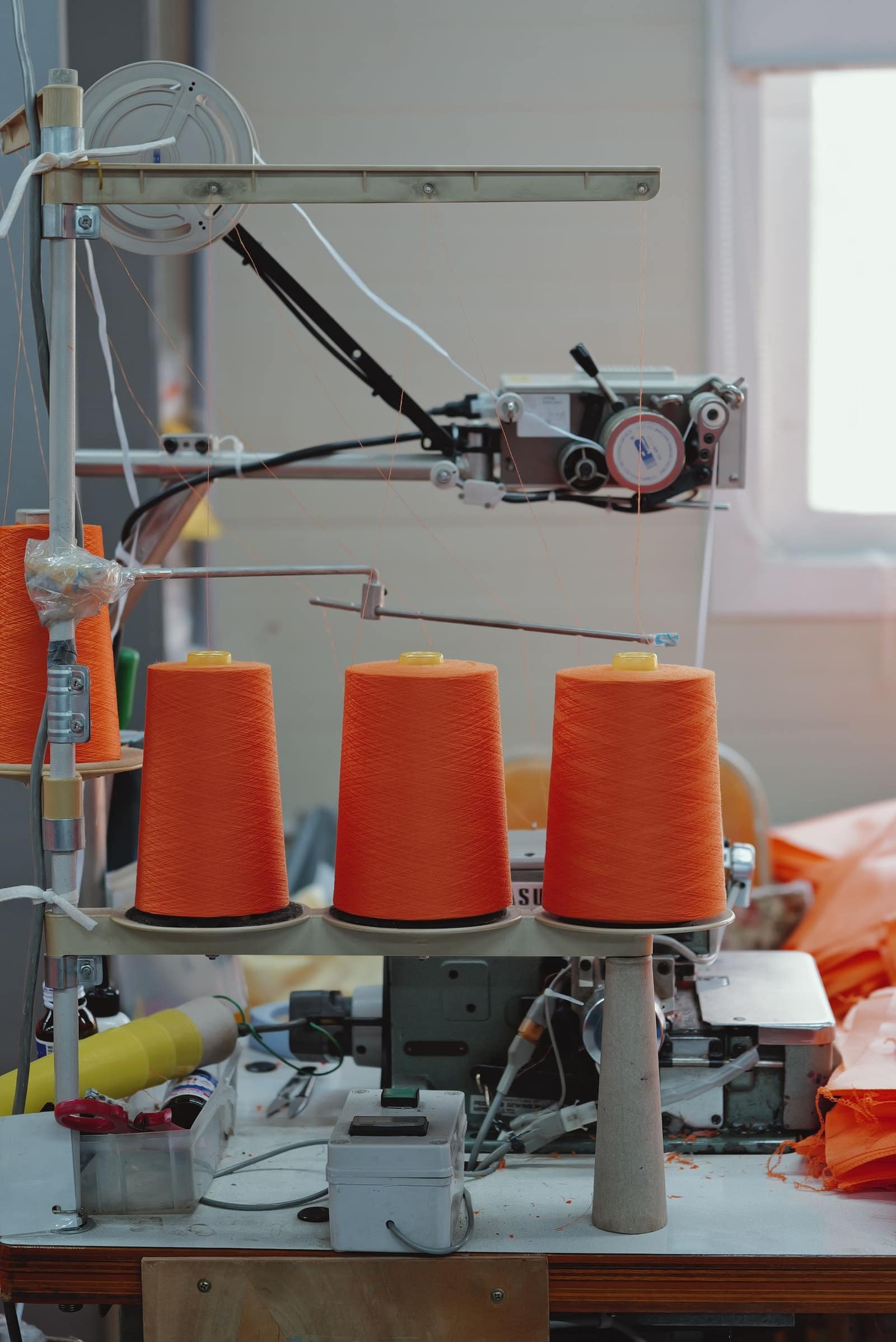
Textiles & apparel
Export polyester and synthetic yarn
Polyester filament and spun yarns from Surat, Silvassa and Bhilwara, sold to weavers and knitters abroad.
- HS code
- 5402 Synthetic filament yarn — polyester POY, FDY and textured yarn, nylon filament (5402) — and spun yarn of synthetic staple fibres, including polyester-cotton and polyester-viscose blends (5509).
- Export policy
- Free to export Free under ITC(HS) Schedule 2; no licence is needed. Confirm the 8-digit line on the DGFT ITC(HS) search before you ship.
- Registrations
- 3 IEC, GST and those below
- India’s exports, 2025-26
- US$ 1.06 bn to 124 countries
What is exported
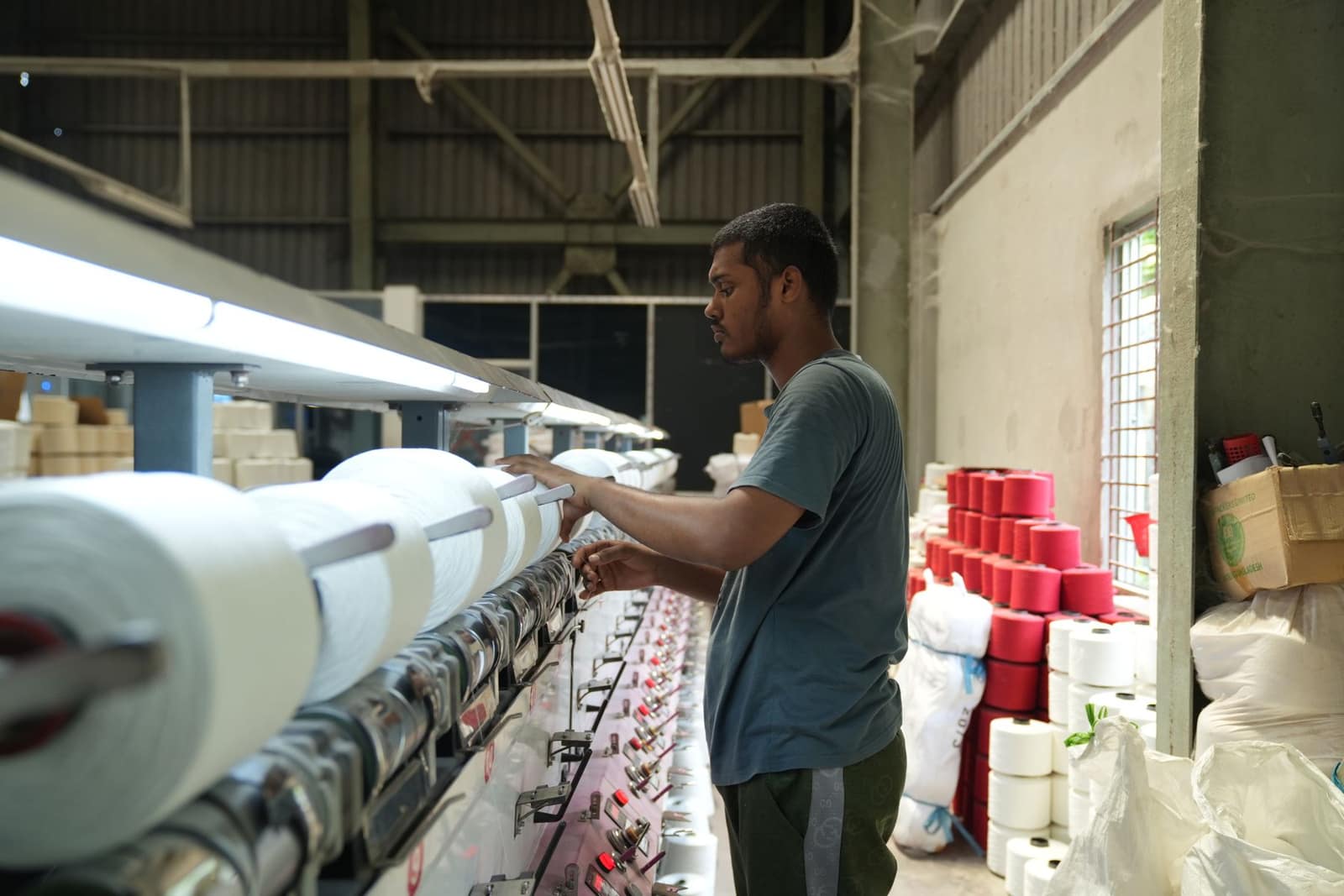
India has large integrated polyester capacity, from PTA and MEG to filament yarn, in Gujarat, Dadra and Nagar Haveli and Maharashtra, and spun-yarn mills in Rajasthan, Punjab and Tamil Nadu. Filament and spun synthetic yarns go to weaving and knitting industries in Bangladesh, Turkey, Egypt, the USA and Latin America. The trade is price-driven and follows crude oil and raw-material prices.
Varieties, grades and forms
- Polyester POY and FDYPartially oriented and fully drawn filament for texturisers and weavers.
- Polyester textured yarn (DTY)For knitting and weaving; grey or dope-dyed.
- Nylon filament yarnFor hosiery, sportswear and narrow fabrics.
- Spun polyester and blends (5509)Polyester-cotton (PC) and polyester-viscose (PV) yarns; sewing yarn.
- Recycled polyester yarnFrom PET bottle flakes, with GRS certification.
Where it is grown or made
- Gujarat and Dadra & Nagar HaveliSurat, Silvassa and Hazira — filament yarn capacity.
- RajasthanBhilwara — PV and PC spun yarn.
- Punjab and MaharashtraLudhiana and Baddi spun-yarn mills; Mumbai and Nagpur filament units.
The quality buyers ask for
- Denier / filaments
- e.g. 150/48, 75/36 for DTY; or Ne count for spun yarn (e.g. 30s PC 65/35)
- Lustre
- Bright, semi-dull or full-dull
- Tenacity and elongation
- To buyer specification, tested per lot
- Uniformity
- Even dye uptake within one merge number; Uster values for spun yarn
Certificates
- RCMCRequiredRegistration with the export promotion council or board for your product (not needed up to ₹3 lakh FOB per consignment since 15 Sep 2026).
- OEKO-TEX STANDARD 100Often askedTests the finished textile for harmful substances; widely asked for by retailers.
- GRSOften askedGlobal Recycled Standard, for recycled-fibre claims.
- ISO 9001Often askedQuality management system; often asked for by industrial buyers.
Shipping, storage and shelf life
Cartons or palletised cones in 40-ft containers, typically about 12–18 tonnes depending on packing.
Sea from Hazira, Mundra and Nhava Sheva; road to Bangladesh and Nepal.
Dry, covered storage; keep cartons upright and away from sunlight.
What goes on the pack and carton
- Fabric and yarn: roll or carton ticket with quality, lot/shade or merge number, length or weight, and “Made in India”.
- Each carton: yarn type, denier/count, lustre, merge or lot number, grade (AA/A), net and gross weight and “Made in India”.
Test at the textile research associations — SITRA (Coimbatore), NITRA (Ghaziabad), BTRA (Mumbai), ATIRA (Ahmedabad) — at Textiles Committee laboratories, or at any NABL-accredited textile lab (search the NABL directory for “textiles” and your city). Retail buyers often name a global test house with labs in India.
Benefits of exporting this product
- RoDTEP: 2.4% of FOB
Tariff item 5402 33 00, 5402 46 00 and 5402 47 00 (polyester textured, partially oriented and other polyester filament yarn) earns 2.4% of FOB value, capped at ₹3 per kg, as a duty credit scrip on ICEGATE (Appendix 4R). Rates continue to 31 Dec 2026 (DGFT Notification 41/2026-27). Confirm your exact 8-digit line on DGFT before pricing an order.
DGFT — Appendix 4R, RoDTEP schedule for DTA exports w.e.f. 10 Oct 2024 (Notification 32/2024-25) ↗ - RoDTEP: 2.5% of FOB
Tariff item 5509 21 00 and 5509 22 00 (yarn of polyester staple fibres, single and multiple) earns 2.5% of FOB value, capped at ₹5.8 per kg, as a duty credit scrip on ICEGATE (Appendix 4R). Polyester blends with viscose, wool or cotton (5509 51 00 to 5509 59 00) earn 2.4%, capped at ₹7.3 per kg. Rates continue to 31 Dec 2026 (DGFT Notification 41/2026-27). Confirm your exact 8-digit line on DGFT before pricing an order.
DGFT — Appendix 4R, RoDTEP schedule for DTA exports w.e.f. 10 Oct 2024 (Notification 32/2024-25) ↗
Where to register
- SRTEPCRCMC from the Synthetic & Rayon Textiles Export Promotion Council for polyester, nylon, viscose and other man-made fibre yarns, fabrics and made-ups.srtepc.org ↗
Quality and checks
- Denier and filament count (or Ne count for spun yarn), tenacity, elongation, dye uptake uniformity and oil pick-up, per lot.
- Some importing countries apply anti-dumping duties on Indian polyester yarn; check the buyer country’s trade-remedy notices before quoting.
Act as a merchant exporter for a Surat or Silvassa yarn maker: send lot samples and test reports to weavers in Bangladesh or Egypt, and start with one container on LC. Since 15 September 2026, a consignment worth up to ₹3 lakh FOB does not need an RCMC (DGFT Notification 36/2026-27). Registrations that a law requires for the product still apply.
Where new exporters go wrong
- Mixing merge numbers (production lots) in one shipment — the fabric shows barre and the buyer claims.
- Ignoring anti-dumping duty in the destination, which can make the deal unviable.
Documents this product needs
Schemes that apply
Trade data
Indian polyester and synthetic yarn exports in numbers
From the Department of Commerce’s TradeStat, country by country. US$, Indian financial years (April–March).
- Exports in 2025-26
- US$ 1.06 bn -1.8% a year on average, 2020-21 to 2025-26
- Change from 2024-25
- ↓ -16.8% US$ 1.28 bn → US$ 1.06 bn
- Buyer countries
- 124
- Average export price
- US$ 1.81 per kg · 5,86,760 tonnes shipped · US$ 1.83 the year before
The price cycle
India’s average export price per kg each year (total value ÷ total quantity). Highest in 2022-23, lowest in 2020-21 — a 33% swing between them. Keep this swing in mind when you quote.
What next: a projection from the trend
The past trend carried forward — not a forecast by any authority. Sudden changes in policy, prices or demand are not in it.
Likely range US$ 727 mn to US$ 1.47 bn.
- Trend
- -5.7% a year
- Fit (R²)
- 0.22 — weak, read with care
- Based on
- 6 years of official figures
Method: a straight line through the logarithm of yearly exports (log-linear regression); range = ±1 standard error.
Biggest buyer countries
By value in 2025-26. Change is against 2024-25.
Where demand is rising and falling
Only countries that buy at least US$ 1 million or 1% of India’s exports of this product. Change from 2024-25 to 2025-26.
↑ High demand
- MalaysiaUS$ 9.1 mn → US$ 16 mn↑+76.2%
- KenyaUS$ 23.3 mn → US$ 28.8 mn↑+24%
- GermanyUS$ 15.9 mn → US$ 18.3 mn↑+14.7%
- NetherlandsUS$ 16.3 mn → US$ 18.1 mn↑+11.5%
↓ Low demand
- RussiaUS$ 27.1 mn → US$ 9.2 mn↓-66.2%
- ChinaUS$ 20 mn → US$ 7 mn↓-65%
- BelgiumUS$ 28 mn → US$ 15.6 mn↓-44.2%
- ArgentinaUS$ 17.4 mn → US$ 11.1 mn↓-36.3%
- South KoreaUS$ 28.5 mn → US$ 18.3 mn↓-35.8%
- CanadaUS$ 13.8 mn → US$ 9.4 mn↓-32%
- ColombiaUS$ 21 mn → US$ 14.8 mn↓-29.7%
- BangladeshUS$ 63.7 mn → US$ 45.4 mn↓-28.8%
Which forms sell, and at what price
India’s exports by 8-digit tariff line, 2025-26. Average price = total value ÷ total quantity (TradeStat): the average of every shipment on that line, not the price of any one deal.
| Tariff line | Value 2025-26 | Change | Quantity | Average price |
|---|---|---|---|---|
Textured yarn of polyesters5402 33 00 · Yarn, synthetic, filament, monofilament, textured, of polyesters, not for retail sale, not sewing thread | US$ 330 mn | ↓-30.2% | 2,42,314 tonnes | US$ 1.36 per kgwas US$ 1.38 |
Other yarn of polyster staple fibrs mixed mainly/solely with cotton5509 53 00 · Yarn,, of polyester staple fibres, mixed mainly or solely with cotton, not put up for retail sale | US$ 184 mn | ↓-0.3% | 90,759 tonnes | US$ 2.03 per kgwas US$ 2.19 |
Other yarn of polystrs,multpl or cabld5402 62 00 · Yarn, synthetic, filament, monofilament, of polyesters, multiple or cabled, not for retail sale, not sewing… | US$ 110 mn | ↓-18.9% | 33,205 tonnes | US$ 3.30 per kgwas US$ 3.38 |
Other yarn of polystr stpl fibrs mixed mainly/solely with artificial staple fibrs5509 51 00 · Yarn,, of polyester staple fibres, mixed mainly or solely with artificial staple fibres, not put up for… | US$ 79.5 mn | ↓-9.1% | 33,197 tonnes | US$ 2.40 per kgwas US$ 2.41 |
Yarn of polyester,prtly orntd,untwstd or with a twist <= 50 turns per mtr, single5402 46 00 · Yarn, synthetic, filament, monofilament, of polyesters, partially oriented, single, untwisted or twisted 50… | US$ 66.1 mn | ↓-19.2% | 69,310 tonnes | US$ 0.95 per kgwas US$ 1.07 |
Multiple(folded)/cabled yrn containing 85% or more by weight of polyestr staple fibres5509 22 00 · Yarn,, multiple or cabled yarn, of synthetic staple fibres, containing 85% or more by weight of polyester… | US$ 43.1 mn | ↑+1.5% | 21,434 tonnes | US$ 2.01 per kgwas US$ 2.12 |
Multiple(folded)/cabled yrn containing>=85% of acrylic/modacrylic staple fibres5509 32 00 · Yarn,, multiple or cabled, of synthetic staple fibres, containing 85% or more by weight of acrylic or… | US$ 33.1 mn | ↓-1% | 8,042 tonnes | US$ 4.12 per kgwas US$ 4.12 |
Single yrn containing 85% or more by weight of polyster staple fibres5509 21 00 · Yarn,, single, of synthetic staple fibres, containing 85% or more by weight of polyester, not put up for… | US$ 32.3 mn | ↓-3.8% | 17,086 tonnes | US$ 1.89 per kgwas US$ 2.01 |
Yarn, synthetic, filament, monofilament, other than high tenacity or textured yarn, elastomeric, single… — elastomeric5402 44 00 | US$ 23.1 mn | ↓-28.7% | 6,725 tonnes | US$ 3.43 per kgwas US$ 3.72 |
Other yarn of nylon or other polymds, multiple(folded)or cabled5402 61 00 · Yarn, synthetic, filament, monofilament, of nylon or other polymides, multiple or cabled, not for retail… | US$ 15.9 mn | ↓-2.5% | 4,263 tonnes | US$ 3.73 per kgwas US$ 3.96 |
Other yarn of polystr stple fibrs mixed mainly/solely with wool/fine animal hair5509 52 00 · Yarn,, of polyester staple fibres, mixed mainly or solely with wool or fine animal hair, not put up for… | US$ 15.7 mn | ↑+5.2% | 1,469 tonnes | US$ 10.71 per kgwas US$ 10.23 |
Yarn, synthetic, filament, monofilament, of polypropylene, single, untwisted or twisted 50 turns or less… — other, of polypropylene5402 48 00 | US$ 13.1 mn | ↑+18.1% | 7,436 tonnes | US$ 1.76 per kgwas US$ 1.76 |
Other polyester (excluding terylene dacron)5402 20 90 · Yarn, synthetic, filament, monofilament, of high tenacity yarn of polyesters, whether or not textured, not… | US$ 12.2 mn | ↑+42.4% | 6,904 tonnes | US$ 1.76 per kgwas US$ 1.93 |
Other yarn of polyester staple fibres5509 59 00 · Yarn,, of polyester staple fibres, mixed mainly or solely with fibres in item no. 5509.5, not put up for… | US$ 10.1 mn | ↑+7.1% | 3,418 tonnes | US$ 2.95 per kgwas US$ 3.03 |
The world market
Each country’s own recorded exports and imports in UN Comtrade, 2023 (the latest year nearly every country has reported).
- World imports
- US$ 21.3 bn 2023
- India among exporters
- #2 of 119 countries
- India’s share of world exports
- 5.7% US$ 1.26 bn
- Left for others to win
- US$ 21 bn exported by other countries
Top exporters — your competitors
- 1ChinaUS$ 9.13 bn 41%
- 2IndiaUS$ 1.26 bn 5.7%
- 3Viet NamUS$ 1.24 bn 5.6%
- 4TürkiyeUS$ 1.14 bn 5.1%
- 5USAUS$ 1.08 bn 4.9%
- 6ItalyUS$ 861 mn 3.9%
- 7NetherlandsUS$ 726 mn 3.3%
- 8Rep. of KoreaUS$ 724 mn 3.3%
- 9IndonesiaUS$ 713 mn 3.2%
- 10Other Asia, nesUS$ 656 mn 2.9%
Biggest buyers in the world
- 1TürkiyeUS$ 1.71 bn 8.1%
- 2IndiaUS$ 1.24 bn 5.8%
- 3Viet NamUS$ 1.11 bn 5.2%
- 4BrazilUS$ 1.02 bn 4.8%
- 5ChinaUS$ 1.01 bn 4.8%
- 6USAUS$ 1 bn 4.7%
- 7Rep. of KoreaUS$ 953 mn 4.5%
- 8ItalyUS$ 909 mn 4.3%
- 9EgyptUS$ 893 mn 4.2%
- 10GermanyUS$ 865 mn 4.1%
Opportunity: what these countries buy from the world, and from India
Each country’s own recorded imports in UN Comtrade, latest year it has reported. The long light part of each bar is demand other countries are filling today.
TradeStat’s 2023-24 quantities are double-counted, so that year is left out of the price. Sources: TradeStat — Export Import Data Bank, Department of Commerce · UN Comtrade database (United Nations Statistics Division) · Figures taken 29 October 2026.
Step by step
How to export polyester and synthetic yarn
China dominates world polyester yarn production and exports; India is the second-largest polyester producer and a major exporter of filament and spun yarns. Large integrated producers give India scale, while smaller spinners in Bhilwara and Punjab specialise in blends. Demand follows global garment and home-textile output, and recycled polyester is growing fast. Trade-remedy duties in some markets are a recurring risk.
- 01Send samples and agree the spec
Send swatches or cones with test reports; fix construction, GSM or count, shade, tolerances, packing and the testing lab in the purchase order.
- 02Check trade remedies
Check whether the buyer country has anti-dumping duty on Indian polyester yarn.
- 03Reserve one merge
Ship each order from a single merge number to avoid shade variation.
- 04Test and pack
Test each lot and pack in labelled cartons or pallets.
- 05Book, stuff and file the shipping bill
Book the container, stuff it at the factory or a CFS, file the shipping bill on ICEGATE with the correct 8-digit code and the RoDTEP/RoSCTL declaration, and get the bill of lading.
- 06Get paid and close the file
Send the original documents through your bank (or to the buyer if paid in advance). Once the money arrives, get the e-BRC and claim RoDTEP, RoSCTL or drawback where they apply.
Meet buyers
Trade fairs
- Alongside Intertextile, spring and autumnYarn Expo (Shanghai)Shanghaiyarnexpo-autumn.hk.messefrankfurt.com ↗
- Usually March and August/SeptemberIntertextile Shanghai Apparel FabricsShanghaiintertextile-shanghai-apparel.hk.messefrankfurt.com ↗
- Next: 31 March–3 April 2027Bharat TexNew Delhibharat-tex.com ↗
- Twice a year — check datesTexworld Evolution ParisParistexworld-paris.fr.messefrankfurt.com ↗
Questions
Questions about exporting polyester and synthetic yarn
Which council handles polyester yarn?
What is a merge number?
Do I need GRS for recycled yarn?
Are there anti-dumping duties abroad?
What RoDTEP applies?
Who buys Indian polyester and synthetic yarn
All countries → SAFTABDTDhakaBangladeshBig neighbour market for cotton, yarn, food and machinery. Mostly LC-based; land and sea routes.From India 2025-26US$ 10.6 bn
 USDWashington, D.C.United States of AmericaIndia's largest single-country export market. Strict FDA rules for food; extra 10% US duty on most goods since July 2026.From India 2025-26US$ 87.3 bn
 EGPCairoEgyptLarge North African market. Every shipment must be pre-registered on Egypt's ACI system before loading.From India 2025-26US$ 3.87 bn
 EURRomeItalyManufacturing buyer of Indian leather, yarn, castings, chemicals and seafood. EU rules apply.From India 2025-26US$ 7.79 bn
 TRYAnkaraTürkiyeLarge manufacturing economy that buys Indian yarn, chemicals and machinery parts. Extra import duties apply to many goods.From India 2025-26US$ 4.54 bn
 PTABRLBrasíliaBrazilLatin America's largest economy. Buys Indian fuels, agrochemicals, medicines, vehicles and yarn; MERCOSUR PTA applies.From India 2025-26US$ 7.02 bn
 PTAARSBuenos AiresArgentinaBig South American market for Indian chemicals, agrochemicals, vehicles and medicines. Import and currency rules change often.From India 2025-26US$ 1.01 bn
 COPBogotáColombiaGrowing Andean market for Indian two-wheelers, medicines, chemicals and yarn. No trade agreement; INVIMA and ICA rules apply.From India 2025-26US$ 1.81 bn
More in textiles & apparel
All products → Free to exportTextiles & apparelCotton yarnBulk cotton yarn sold to weaving and knitting mills abroad; Bangladesh is by far the largest buyer.HS5205Exports 2025-26US$ 3.22 bn ↓4.1%
 Free to exportTextiles & apparelReadymade garmentsKnitted and woven clothing for brands and retailers; the USA, UK, UAE and the EU are the big buyers.HS6109.10Exports 2025-26US$ 15.8 bn ↓1.2%
 Free to exportTextiles & apparelHome textiles (bed, bath and kitchen linen)Bedsheets, towels and kitchen linen for retailers; the USA buys more than half of India's exports.HS6302Exports 2025-26US$ 2.01 bn ↓5.7%
 Free to exportTextiles & apparelHandloom productsHand-woven fabrics, stoles and furnishings; buyers pay for craft, story and certified handloom origin.HS6304Exports 2025-26US$ 1.75 bn ↓8.6%