


Processed food
Export raisins
Green and golden raisins from Sangli, Nashik and Vijayapura for Sri Lanka, South-East Asia and the Gulf.
- HS code
- 0806.20 Dried grapes (0806 20): raisins (0806 20 10) and other (0806 20 90).
- Export policy
- Free to export Export is Free under ITC(HS); we found no recent restriction. Confirm current status on dgft.gov.in.
- Registrations
- 5 IEC, GST and those below
- India’s exports, 2025-26
- US$ 29.5 mn to 61 countries
What is exported
Raisin exports were about US$ 30 million in 2025-26 (TradeStat), led by Morocco, Sri Lanka, Vietnam, Indonesia, Malaysia and Saudi Arabia. India’s raisins are made mostly from Thompson Seedless grapes, the variety on about four-fifths of grape area (APEDA). Turkey, Iran and the USA dominate world raisin trade, so Indian exporters win on price and on the green raisin style.
Varieties, grades and forms
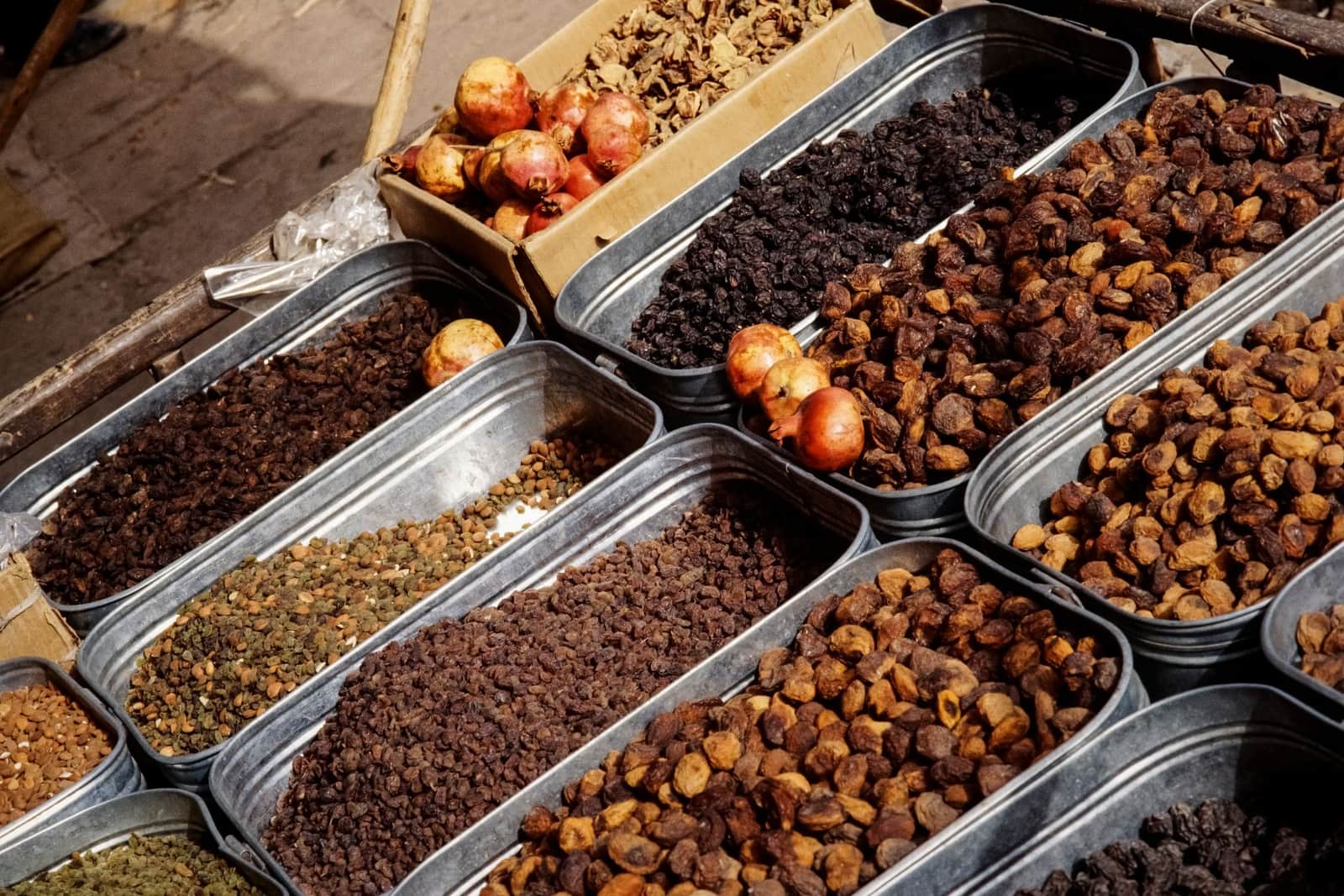
- Green (shade-dried) raisinsThe typical Indian style, dipped and dried in shade.
- Golden (sulphured) raisinsTreated with sulphur dioxide for colour; must be declared where required.
- Black raisinsSun-dried, from seedless and coloured grapes.
Where it is grown or made
- MaharashtraSangli (Tasgaon), Nashik, Solapur — Maharashtra grows about 69% of India’s grapes (APEDA).
- KarnatakaVijayapura, Bagalkot, Belagavi — the second-largest grape state.
The quality buyers ask for
- Grade
- By colour, size and uniformity (trade grades set by buyers)
- Moisture and defects
- Moisture, stems, caps, damaged berries and foreign matter maxima in contract
- Sulphur dioxide
- Within destination limits; declared above 10 mg/kg in the EU
- Contaminants
- Ochratoxin A and pesticide residues within destination limits
Certificates
- APEDA RCMCRequiredRegistration with APEDA, issued as an RCMC on the DGFT portal; not needed for consignments up to ₹3 lakh FOB since 15 Sep 2026.
- FSSAI licenceRequiredCentral licence from FSSAI for the premises where food is packed or stored for export.
- Phytosanitary certificateRequiredIssued by Plant Quarantine (DPPQS) for each consignment after inspection; apply on PQMS.
- HACCPOften askedFood-safety plan for the processing unit; most importers ask for it.
- BRCGS Food SafetyOften askedGFSI standard asked for by UK and many EU retailers for private-label packing.
- HalalOften askedAsked for by many Gulf, Malaysian and Indonesian buyers of processed foods; use a body the destination recognises.
Shipping, storage and shelf life
A 20-ft container typically carries about 18–20 tonnes in cartons.
Sea from JNPA or Mundra; reefers preferred in hot months.
Cold storage typically about 2–5 °C to hold colour.
Typically about 12 months in cold storage.
What goes on the pack and carton
- EU retail packs (Regulation 1169/2011): food name, ingredients with allergens highlighted, net quantity, best-before date, storage conditions, EU importer’s name and address, and origin where required — in the language of the country of sale.
- USA (21 CFR 101): product name, net quantity in US and metric units, ingredients, allergens, packer or distributor name and address, Nutrition Facts unless exempt, and "Product of India".
- Gulf countries: Arabic text (Arabic plus English is normal), production and expiry dates, net weight, country of origin and importer details. Confirm current rules with your importer.
- Lot or batch number on every pack and bag — required by FSSAI’s Labelling and Display Regulations, 2020, and used by every importing country to trace and recall.
Use a laboratory on APEDA’s list of recognised laboratories (apeda.gov.in → Recognised Organisations), an FSSAI-notified lab, or a lab accredited by NABL for the test (nabl-india.org). Ask the buyer which reports they accept before sending samples.
Benefits of exporting this product
- RoDTEP refund on this line
Raisins (0806 20 10) and other dried grapes (0806 20 90) carry 2.4% of FOB, capped at ₹4.3 per kg. Rate as listed in Appendix 4R (w.e.f. 10 Oct 2024); DGFT Notification 41/2026-27 keeps the rates in force on 30 Sep 2026 unchanged until 31 Dec 2026. Check your exact 8-digit line on dgft.gov.in before you price.
DGFT — Appendix 4R, RoDTEP schedule for DTA exports w.e.f. 10 Oct 2024 (Notification No. 32, 30 Sep 2024) ↗ - APEDA support (Bharat Krishi Niryat Yojana)
APEDA’s financial assistance scheme for 2026-27 to 2030-31 helps registered exporters, FPOs and processors with packhouses, cold chain, testing, quality systems and market development. Read the component conditions before you spend.
APEDA — Bharat Krishi Niryat Yojana 2026-27 to 2030-31, operational guidelines (6 Oct 2026) ↗
Where to register
- APEDARegistration-cum-Membership Certificate (RCMC) for APEDA-scheduled products. Apply on the DGFT portal after you have your IEC.dgft.gov.in ↗
- FSSAIFood business licence. FSSAI puts food exporters under the Central licence; apply on FoSCoS for the premises you pack from.foscos.fssai.gov.in ↗
- Plant Quarantine (DPPQS)Phytosanitary certificate for each consignment of plant produce, applied for online on PQMS. Some markets also want the packhouse or processing unit registered.pqms.cgg.gov.in ↗
Quality and checks
- Pesticide residues must meet the destination country’s MRLs; check them in APEDA’s International Pesticide MRL Database before you buy the crop.
- Sulphur dioxide in golden raisins must be within the buyer country’s limit and declared on the label where required (the EU lists sulphites above 10 mg/kg as an allergen).
- Ochratoxin A, moisture, stems, caps and foreign matter; size and colour uniformity by grade.
- Test each lot at an NABL-accredited or board laboratory before shipment and keep the report with the lot number.
Buy cleaned, graded raisins from a cold store in Tasgaon (Sangli) or Vijayapura, test residues and sulphite, and send a 20-ft container in 10–15 kg cartons to a dry-fruit importer in Sri Lanka or Malaysia. Since 15 September 2026, a consignment worth up to ₹3 lakh FOB does not need an RCMC (DGFT Notification 36/2026-27); registrations required by a law still apply.
Where new exporters go wrong
- Taking raisins out of cold storage long before loading — they darken and sugar crystallises.
- Undeclared sulphites in golden raisins for the EU or USA — recalls follow.
Documents this product needs
Schemes that apply
- RoDTEP Remission of Duties and Taxes on Exported Products
- Drawback Duty Drawback (All Industry Rates)
- LUT Letter of Undertaking for zero-rated exports under GST
- ECGC ECGC export credit insurance for small exporters
- Districts as Export Hubs Districts as Export Hubs
- EPM Export Promotion Mission (Niryat Protsahan and Niryat Disha)
Sources (5)
- Department of Commerce — TradeStat, India’s exports by commodity and country (2025-26)
- APEDA — Grapes product profile (varieties and growing states)
- APEDA — International Pesticide MRL Database
- EU — Regulation (EU) No 1169/2011 on food information to consumers
- DGFT Notification 36/2026-27 (15 Sep 2026) — no RCMC needed for consignments up to ₹3 lakh FOB
Trade data
Indian raisins exports in numbers
From the Department of Commerce’s TradeStat, country by country. US$, Indian financial years (April–March).
- Exports in 2025-26
- US$ 29.5 mn -0.1% a year on average, 2020-21 to 2025-26
- Change from 2024-25
- ↓ -60.3% US$ 74.3 mn → US$ 29.5 mn
- Buyer countries
- 61
- Average export price
- US$ 1.97 per kg · 14,995 tonnes shipped · US$ 1.52 the year before
The price cycle
India’s average export price per kg each year (total value ÷ total quantity). Highest in 2025-26, lowest in 2020-21 — a 65% swing between them. Keep this swing in mind when you quote.
What next: a projection from the trend
The past trend carried forward — not a forecast by any authority. Sudden changes in policy, prices or demand are not in it.
Likely range US$ 32.4 mn to US$ 128 mn.
- Trend
- +11.5% a year
- Fit (R²)
- 0.2 — weak, read with care
- Based on
- 6 years of official figures
Method: a straight line through the logarithm of yearly exports (log-linear regression); range = ±1 standard error.
Biggest buyer countries
By value in 2025-26. Change is against 2024-25.
Where demand is rising and falling
Only countries that buy at least US$ 1 million or 1% of India’s exports of this product. Change from 2024-25 to 2025-26.
↑ High demand
↓ Low demand
- IraqUS$ 2.7 mn → US$ 190k↓-93%
- United Arab EmiratesUS$ 1.5 mn → US$ 160k↓-89.1%
- RussiaUS$ 2.9 mn → US$ 360k↓-87.5%
- BangladeshUS$ 4.9 mn → US$ 670k↓-86.4%
- ThailandUS$ 1.1 mn → US$ 180k↓-83%
- NigeriaUS$ 1.4 mn → US$ 260k↓-81.7%
- RomaniaUS$ 3 mn → US$ 710k↓-76.6%
- NepalUS$ 1.9 mn → US$ 470k↓-75%
Which forms sell, and at what price
India’s exports by 8-digit tariff line, 2025-26. Average price = total value ÷ total quantity (TradeStat): the average of every shipment on that line, not the price of any one deal.
| Tariff line | Value 2025-26 | Change | Quantity | Average price |
|---|---|---|---|---|
Fruit, edible, grapes, dried — raisins0806 20 10 | US$ 27.9 mn | ↓-61.4% | 13,718 tonnes | US$ 2.03 per kgwas US$ 1.54 |
Sultanas and other dried grapes0806 20 90 · Fruit, edible, grapes, dried | US$ 1.7 mn | ↓-24% | 1,278 tonnes | US$ 1.31 per kgwas US$ 0.95 |
The world market
Each country’s own recorded exports and imports in UN Comtrade, 2023 (the latest year nearly every country has reported).
- World imports
- US$ 1.54 bn 2023
- India among exporters
- #8 of 100 countries
- India’s share of world exports
- 3.3% US$ 54.1 mn
- Left for others to win
- US$ 1.58 bn exported by other countries
Top exporters — your competitors
- 1TürkiyeUS$ 508 mn 31%
- 2IranUS$ 223 mn 13.6%
- 3USAUS$ 175 mn 10.7%
- 4ChileUS$ 143 mn 8.7%
- 5South AfricaUS$ 116 mn 7.1%
- 6UzbekistanUS$ 77.5 mn 4.7%
- 7ChinaUS$ 69.2 mn 4.2%
- 8IndiaUS$ 54.1 mn 3.3%
- 9United Arab EmiratesUS$ 47.6 mn 2.9%
- 10ArgentinaUS$ 43 mn 2.6%
Biggest buyers in the world
- 1United KingdomUS$ 151 mn 9.8%
- 2GermanyUS$ 140 mn 9.1%
- 3NetherlandsUS$ 108 mn 7%
- 4IndiaUS$ 85.1 mn 5.5%
- 5JapanUS$ 80.3 mn 5.2%
- 6CanadaUS$ 61.1 mn 4%
- 7BrazilUS$ 56.3 mn 3.6%
- 8FranceUS$ 55.7 mn 3.6%
- 9USAUS$ 51.8 mn 3.4%
- 10TürkiyeUS$ 49.5 mn 3.2%
Opportunity: what these countries buy from the world, and from India
Each country’s own recorded imports in UN Comtrade, latest year it has reported. The long light part of each bar is demand other countries are filling today.
TradeStat’s 2023-24 quantities are double-counted, so that year is left out of the price. Sources: TradeStat — Export Import Data Bank, Department of Commerce · UN Comtrade database (United Nations Statistics Division) · Figures taken 29 October 2026.
Step by step
How to export raisins
Turkey, Iran, the USA and Uzbekistan lead the world raisin trade; India is a smaller exporter whose green, shade-dried raisins are a distinct style. Most Indian raisins are eaten at home, and India also imports raisins. Exports go to Sri Lanka, South-East Asia, the Gulf and North Africa. Openings: residue-tested, well-graded raisins in retail packs and golden raisins with correct sulphite labelling.
- 01Register
Get your IEC, APEDA RCMC and FSSAI licence.
- 02Buy from cold store
Buy graded raisins at Tasgaon, Sangli or Vijayapura cold stores; inspect colour and moisture.
- 03Clean, grade and test
Machine-clean, remove stems and caps, and test residues, sulphite and ochratoxin.
- 04Pack and label
Pack in lined cartons or retail pouches labelled for the market.
- 05Inspection and phytosanitary certificate
Apply on PQMS; Plant Quarantine inspects the lot (and fumigation or treatment if the importing country requires it) before issuing the certificate.
- 06File the shipping bill and ship
Your customs broker files the shipping bill on ICEGATE with the invoice and packing list. After customs clearance the line issues the bill of lading; get the certificate of origin from the right agency if the buyer needs a trade-agreement rate.
- 07Get paid and close the file
Send original documents through your bank (or to the buyer if paid in advance). When the money arrives, get the e-BRC and claim RoDTEP and drawback where they apply.
Questions
Questions about exporting raisins
Where are Indian raisins made?
Do golden raisins need special labelling?
Who buys Indian raisins?
What RoDTEP do raisins get?
Do I need an RCMC for a small trial shipment?
Sources (5)
- APEDA — Grapes product profile (varieties and growing states)
- Department of Commerce — TradeStat, India’s exports by commodity and country (2025-26)
- DGFT — Appendix 4R, RoDTEP schedule for DTA exports w.e.f. 10 Oct 2024 (Notification No. 32, 30 Sep 2024)
- EU — Regulation (EU) No 1169/2011 on food information to consumers
- APEDA — International Pesticide MRL Database
Who buys Indian raisins
All countries → ISFTALKRSri Jayawardenepura Kotte (Colombo is the commercial capital)Sri LankaClose island market with India's oldest FTA. Buys food, medicines, vehicles, yarn and building materials.From India 2025-26US$ 5.52 bn
 AITIGAVNDHanoiVietnamFast-growing manufacturing economy buying raw materials, yarn, steel, chemicals and feed ingredients from India.From India 2025-26US$ 6.67 bn
 AITIGAIDRJakartaIndonesiaWorld's fourth most populous country. Buys Indian vehicles, steel, chemicals, groundnuts and meat; halal and BPOM rules for food.From India 2025-26US$ 4.49 bn
 CECAMYRKuala LumpurMalaysiaMulti-ethnic market with a large Indian-origin community. Halal expectations for food; CECA and AITIGA both apply.From India 2025-26US$ 6.83 bn
 SARRiyadhSaudi ArabiaLarge Gulf market for rice, food and engineering goods. Strict SFDA food rules and SABER certification for regulated goods.From India 2025-26US$ 10.3 bn
More in processed food
All products → Free to exportProcessed foodTeaAssam, Darjeeling, Nilgiri and CTC tea. You need a Tea Board exporter licence; residues and GI rules matter.HS0902Exports 2025-26US$ 899 mn ↑8%
 Free to exportProcessed foodCoffeeArabica and Robusta green beans, monsooned and instant coffee. Coffee Board registration and an export permit for every shipment.HS0901.11Exports 2025-26US$ 1.41 bn ↑13%
 Free, with conditionsProcessed foodNatural honeyMustard, multiflora and other honeys, mostly to the USA. A minimum export price of US$ 1,400/tonne applies till 31 Dec 2026.HS0409.00Exports 2025-26US$ 208 mn ↑0.7%
 Free to exportProcessed foodMakhana (fox nut)Popped and flavoured makhana from Bihar for health-snack shelves in the USA, UK and Middle East. Small volumes, strong packaging needs.HS2008.19Exports 2025-26US$ 21.8 mn