

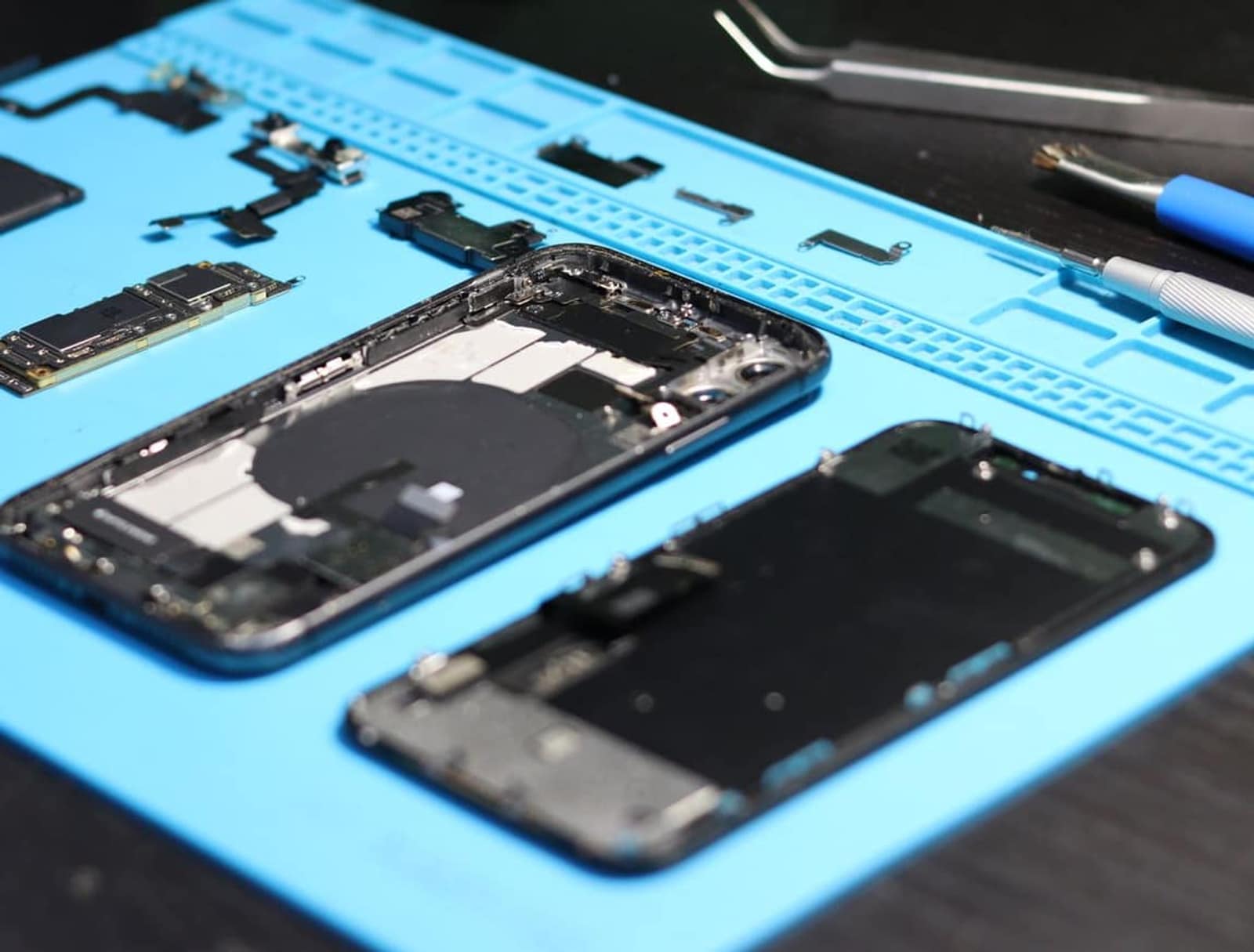
Engineering goods
Export mobile phones
India's largest single electronics export, led by big assemblers; the USA and UAE take most of it.
- HS code
- 8517.13 Smartphones (8517.13); other phones for cellular networks are in 8517.14.
- Export policy
- Free to export Free to export under ITC(HS) Schedule 2 as checked in November 2026. Phones are mass-market goods, so the encryption controls in SCOMET Category 8 do not usually apply; check if you ship special secure devices. Used phones and e-waste follow separate rules. Confirm your exact 8-digit line on the DGFT ITC(HS) search before you ship.
- Registrations
- 3 IEC, GST and those below
- India’s exports, 2025-26
- US$ 29.4 bn to 59 countries
What is exported
Smartphone exports grew fast after the PLI scheme for large-scale electronics manufacturing; most phones are assembled in Noida, Chennai–Sriperumbudur, Bengaluru–Hosur and Hyderabad by global brands and their contract makers. In 2025-26 India exported about US$ 29.4 billion of smartphones (HS 8517.13); the USA took about two-thirds, followed by the UAE, Austria, the Netherlands and the UK. For a small exporter, the real openings are as an authorised distributor-exporter of Indian-made brands, or in accessories and parts.
Varieties, grades and forms
- SmartphonesThe bulk of exports; premium and mid-range models from global and Indian brands.
- Feature phonesBasic phones (8517.14) for Africa and South Asia.
- Parts and accessoriesChargers, batteries, cases, PCBAs and displays.
Where it is grown or made
- Uttar PradeshNoida and Greater Noida
- Tamil NaduChennai–Sriperumbudur and Hosur
- KarnatakaBengaluru region
- Telangana and Andhra PradeshHyderabad and Tirupati
The quality buyers ask for
- Network bands
- 2G/4G/5G bands that match the operators of the target market
- Charger and port
- USB-C for the EU under the common charger rule; plug type of the market
- Battery
- Lithium-ion cell tested to UN 38.3 and IEC 62133
- Software and language
- Local language support and regional software builds
- SAR
- Specific absorption rate within the destination limit (for example the FCC or EU limit)
Certificates
- CE (Radio Equipment Directive)Often askedRequired for phones sold in the EU.
- FCC equipment authorisationOften askedRequired for phones sold in the USA.
- Local type approval (TDRA, CST and others)RequiredTelecom regulators in the Gulf and elsewhere approve each model.
- UN 38.3 battery test summaryRequiredNeeded to ship lithium batteries by air or sea.
- Brand distribution authorisationRequiredWritten authority from the brand owner; protects warranty and avoids seizure.
Shipping, storage and shelf life
High value, low volume: most phones move by air in palletised master cartons; sea is used for large, planned volumes.
Air freight under IATA lithium-battery rules (PI 966/967).
Secure, climate-controlled storage; theft risk is high.
What goes on the pack and carton
- Model, IMEI, maker and importer details, regulatory marks (CE, FCC ID) and battery information.
- Lithium battery handling mark on outer cartons where required.
- Country of origin "Made in India".
MeitY's STQC laboratories and NABL-accredited electronics labs test safety, EMC and radio performance; many global certification bodies have labs in India. Battery UN 38.3 tests are done by NABL-accredited battery labs.
Benefits of exporting this product
- RoDTEP: ₹24.50 per smartphone
Appendix 4R lists smartphones (8517 13 00) and other cellular phones (8517 14 00) at a fixed ₹24.50 per unit rather than a percentage of FOB. These rates continue to 31 Dec 2026 (DGFT Notification 41/2026-27). Confirm the entry on the DGFT RoDTEP page before you price.
DGFT — Appendix 4R, RoDTEP schedule for DTA exports w.e.f. 10.10.2024 (Notification 32/2024-25); rates continued to 31.12.2026 by Notification 41/2026-27 ↗ - Duty drawback: 4% of FOB
Drawback item 851701 (cellular mobile phones, with or without accessories) has an All Industry Rate of 4% of FOB, capped at ₹350 per piece, paid into your bank account. It is not available on exports under Advance Authorisation or from EOU/SEZ units. Check the current schedule on the CBIC drawback page before shipping.
Gazette of India — Notification 77/2023-Customs (N.T.) dated 20.10.2023: All Industry Rates of duty drawback ↗ - PLI scheme for manufacturers
The PLI scheme for mobile manufacturing and specified electronic components is one of the 14 Production Linked Incentive schemes listed by the Government (PIB, December 2024). The incentive goes only to approved manufacturers on their eligible sales, not to traders, but it is why new export-grade capacity is coming up — a useful source of supply for a merchant exporter. Check the scheme guidelines and current status on the ministry's site.
PIB — Scaling New Heights: How the PLI Scheme is Reshaping Industries (21 Dec 2024), list of the 14 PLI sectors ↗
Where to register
- MEDEPC (Mobile and Electronic Devices EPC)Smartphones, other mobile phones and their parts are listed under MEDEPC in Appendix 2T. ESC and TEPC also cover electronics and telecom equipment.medepc.org ↗
Quality and checks
- EU: CE marking under the Radio Equipment Directive, including the common USB-C charger rule; RoHS and WEEE obligations.
- USA: FCC equipment authorisation; Gulf: telecom type approval (for example TDRA in the UAE, CST in Saudi Arabia).
- Lithium batteries inside phones: UN 38.3 test summary and dangerous-goods rules for air shipment (IATA PI 966/967).
Do not try to build phones. Approach Indian brands for written distribution rights in one or two markets (Gulf, Africa, Nepal), confirm the models hold type approval there, and ship by air on advance payment. Accessories (chargers, cases, cables) are an easier first product.
Where new exporters go wrong
- Grey-market trading without brand authorisation — warranties fail and customs may seize goods.
- Air shipments refused because battery documents are missing.
- Models without local type approval or the right frequency bands.
Documents this product needs
Schemes that apply
- RoDTEP Remission of Duties and Taxes on Exported Products
- Drawback Duty Drawback (All Industry Rates)
- Advance Authorisation Advance Authorisation
- EPCG Export Promotion Capital Goods Scheme
- ECGC ECGC export credit insurance for small exporters
- LUT Letter of Undertaking for zero-rated exports under GST
- Status Holder Status Holder certificate (One to Five Star Export House)
Sources (7)
- Department of Commerce, Export Import Data Bank — India's exports of HS 851713 by country, 2025-26
- DGFT — Appendix 2T: Export Promotion Councils and the products under each
- DGFT — ITC(HS) export policy search (Schedule 2) and SCOMET list (Appendix 3)
- Mobile and Electronic Devices Export Promotion Council (MEDEPC) — official site
- European Commission — Radio Equipment Directive (RED)
- IATA — Lithium batteries: Dangerous Goods Regulations guidance
- PIB — Scaling New Heights: How the PLI Scheme is Reshaping Industries (21 Dec 2024), list of the 14 PLI sectors
Trade data
Indian mobile phones exports in numbers
From the Department of Commerce’s TradeStat, country by country. US$, Indian financial years (April–March).
- Exports in 2025-26
- US$ 29.4 bn +38.9% a year on average, 2022-23 to 2025-26
- Change from 2024-25
- ↑ +21.6% US$ 24.1 bn → US$ 29.4 bn
- Buyer countries
- 59
- Average export price
- US$ 349.24 per kg · 84,078 tonnes shipped · US$ 348.65 the year before
The price cycle
India’s average export price per kg each year (total value ÷ total quantity). Highest in 2025-26, lowest in 2022-23 — a 50% swing between them. Keep this swing in mind when you quote.
What next: a projection from the trend
The past trend carried forward — not a forecast by any authority. Sudden changes in policy, prices or demand are not in it.
Likely range US$ 52.9 bn to US$ 70.8 bn.
- Trend
- +40.4% a year
- Fit (R²)
- 0.98
- Based on
- 4 years of official figures
Method: a straight line through the logarithm of yearly exports (log-linear regression); range = ±1 standard error.
Biggest buyer countries
By value in 2025-26. Change is against 2024-25.
Where demand is rising and falling
Only countries that buy at least US$ 1 million or 1% of India’s exports of this product. Change from 2024-25 to 2025-26.
↑ High demand
- United States of AmericaUS$ 10.6 bn → US$ 19.7 bn↑+86.3%
- United Arab EmiratesUS$ 2.77 bn → US$ 4.07 bn↑+47.2%
↓ Low demand
- JapanUS$ 517 mn → US$ 56.3 mn↓-89.1%
- ItalyUS$ 1.26 bn → US$ 410 mn↓-67.4%
- CzechiaUS$ 1.17 bn → US$ 397 mn↓-66.2%
- NetherlandsUS$ 2.2 bn → US$ 785 mn↓-64.4%
- United KingdomUS$ 1.48 bn → US$ 619 mn↓-58.1%
- FranceUS$ 315 mn → US$ 269 mn↓-14.5%
- AustriaUS$ 972 mn → US$ 844 mn↓-13.1%
Which forms sell, and at what price
India’s exports by 8-digit tariff line, 2025-26. Average price = total value ÷ total quantity (TradeStat): the average of every shipment on that line, not the price of any one deal.
| Tariff line | Value 2025-26 | Change | Quantity | Average price |
|---|---|---|---|---|
Telephone sets, smartphones for cellular or other wireless networks — smartphones8517 13 00 | US$ 29.4 bn | ↑+21.6% | 84.1 mn pieces | US$ 349.24 per piecewas US$ 348.65 |
The world market
Each country’s own recorded exports and imports in UN Comtrade, 2023 (the latest year nearly every country has reported).
- World imports
- US$ 309.5 bn 2023
- India among exporters
- #5 of 117 countries
- India’s share of world exports
- 5% US$ 14.3 bn
- Left for others to win
- US$ 273.5 bn exported by other countries
Top exporters — your competitors
- 1ChinaUS$ 136.7 bn 47.5%
- 2Viet NamUS$ 26.5 bn 9.2%
- 3China, Hong Kong SARUS$ 26.3 bn 9.1%
- 4United Arab EmiratesUS$ 25.4 bn 8.8%
- 5IndiaUS$ 14.3 bn 5%
- 6CzechiaUS$ 10.8 bn 3.8%
- 7USAUS$ 9.22 bn 3.2%
- 8SingaporeUS$ 5.44 bn 1.9%
- 9SlovakiaUS$ 4 bn 1.4%
- 10GermanyUS$ 3.53 bn 1.2%
Biggest buyers in the world
- 1USAUS$ 59.6 bn 19.3%
- 2United Arab EmiratesUS$ 36.8 bn 11.9%
- 3China, Hong Kong SARUS$ 35.6 bn 11.5%
- 4JapanUS$ 17.4 bn 5.6%
- 5GermanyUS$ 12.7 bn 4.1%
- 6United KingdomUS$ 11.2 bn 3.6%
- 7CzechiaUS$ 10.9 bn 3.5%
- 8CanadaUS$ 6.83 bn 2.2%
- 9NetherlandsUS$ 6.76 bn 2.2%
- 10ItalyUS$ 6.75 bn 2.2%
Opportunity: what these countries buy from the world, and from India
Each country’s own recorded imports in UN Comtrade, latest year it has reported. The long light part of each bar is demand other countries are filling today.
TradeStat’s 2023-24 quantities are double-counted, so that year is left out of the price. Sources: TradeStat — Export Import Data Bank, Department of Commerce · UN Comtrade database (United Nations Statistics Division) · Figures taken 29 October 2026.
Step by step
How to export mobile phones
India has become one of the largest smartphone assemblers in the world, and phones are now its largest single electronics export, led by global brands and their contract makers. China and Vietnam remain the main competing production bases. Demand comes from US and European brands spreading production beyond China, from the Gulf as a re-export hub, and from price-sensitive markets in Africa and South Asia. For a smaller exporter, openings are in distributing Indian brands, accessories, and parts supplied to assemblers.
- 01Secure brand rights
Get written distribution rights for named countries.
- 02Check approvals
Confirm type approval and bands for each model in each market.
- 03Agree terms
Price, warranty support and marketing support with the brand and buyer.
- 04Prepare documents
Invoice, IMEI list, battery DG documents.
- 05Ship by air
Book with a forwarder experienced in lithium battery cargo; insure fully.
- 06Claim benefits
RoDTEP and drawback on the shipping bill.
- 07Payment
Advance payment or confirmed LC; never open account with a new buyer.
Questions
Questions about exporting mobile phones
Can I export phones I buy from the Indian market?
What RoDTEP applies?
And duty drawback?
Which council?
Can phones go by sea?
Sources (7)
- Mobile and Electronic Devices Export Promotion Council (MEDEPC) — official site
- European Commission — Radio Equipment Directive (RED)
- IATA — Lithium batteries: Dangerous Goods Regulations guidance
- STQC Directorate, MeitY — electronics testing and certification
- DGFT — Appendix 4R, RoDTEP schedule for DTA exports w.e.f. 10.10.2024 (Notification 32/2024-25); rates continued to 31.12.2026 by Notification 41/2026-27
- Gazette of India — Notification 77/2023-Customs (N.T.) dated 20.10.2023: All Industry Rates of duty drawback
- PIB — Scaling New Heights: How the PLI Scheme is Reshaping Industries (21 Dec 2024), list of the 14 PLI sectors
Who buys Indian mobile phones
All countries → USDWashington, D.C.United States of AmericaIndia's largest single-country export market. Strict FDA rules for food; extra 10% US duty on most goods since July 2026.From India 2025-26US$ 87.3 bn
 CEPAAEDAbu DhabiUnited Arab EmiratesIndia's biggest Gulf buyer and a re-export hub for the Middle East and Africa. CEPA in force since 2022.From India 2025-26US$ 37.4 bn
 EURAmsterdamNetherlandsEurope's main gateway: Rotterdam handles goods for the whole EU. EU food-safety and residue rules apply.From India 2025-26US$ 17.5 bn
 CETAGBPLondonUnited KingdomNew CETA in force since July 2026 — most Indian goods now enter duty-free. Strong market for garments, food and engineering.From India 2025-26US$ 13.4 bn
 EURBerlinGermanyEurope's largest economy and India's biggest EU partner. Values quality, certificates and supply-chain transparency.From India 2025-26US$ 11.5 bn
 EURRomeItalyManufacturing buyer of Indian leather, yarn, castings, chemicals and seafood. EU rules apply.From India 2025-26US$ 7.79 bn
 EURMadridSpainGrowing EU buyer of Indian garments, seafood, chemicals and auto parts; Valencia and Algeciras are key ports.From India 2025-26US$ 6.96 bn
 EURParisFranceFashion, food and design market. EU rules plus French-language labels; SIAL Paris is a key food fair.From India 2025-26US$ 7.1 bn
More in engineering goods
All products → Free to exportEngineering goodsAuto parts and componentsOEM and aftermarket vehicle parts; the USA, Germany and Italy buy most, with strong demand in Latin America.HS8708Exports 2025-26US$ 7.64 bn ↑1.8%
 Free to exportEngineering goodsIron and steel castingsGrey and ductile iron and steel castings from Kolhapur, Rajkot, Coimbatore and Howrah; the USA leads.HS7325Exports 2025-26US$ 1.25 bn ↑3.2%
 Free to exportEngineering goodsHand toolsHammers, wrenches, pliers and garden tools from Jalandhar and Ludhiana; the USA buys most.HS8205Exports 2025-26US$ 161 mn ↓7%
 Free to exportEngineering goodsPumpsAgricultural, domestic and industrial pumps from Coimbatore, Rajkot and Ahmedabad; the USA leads.HS8413Exports 2025-26US$ 1.6 bn ↑5.2%