

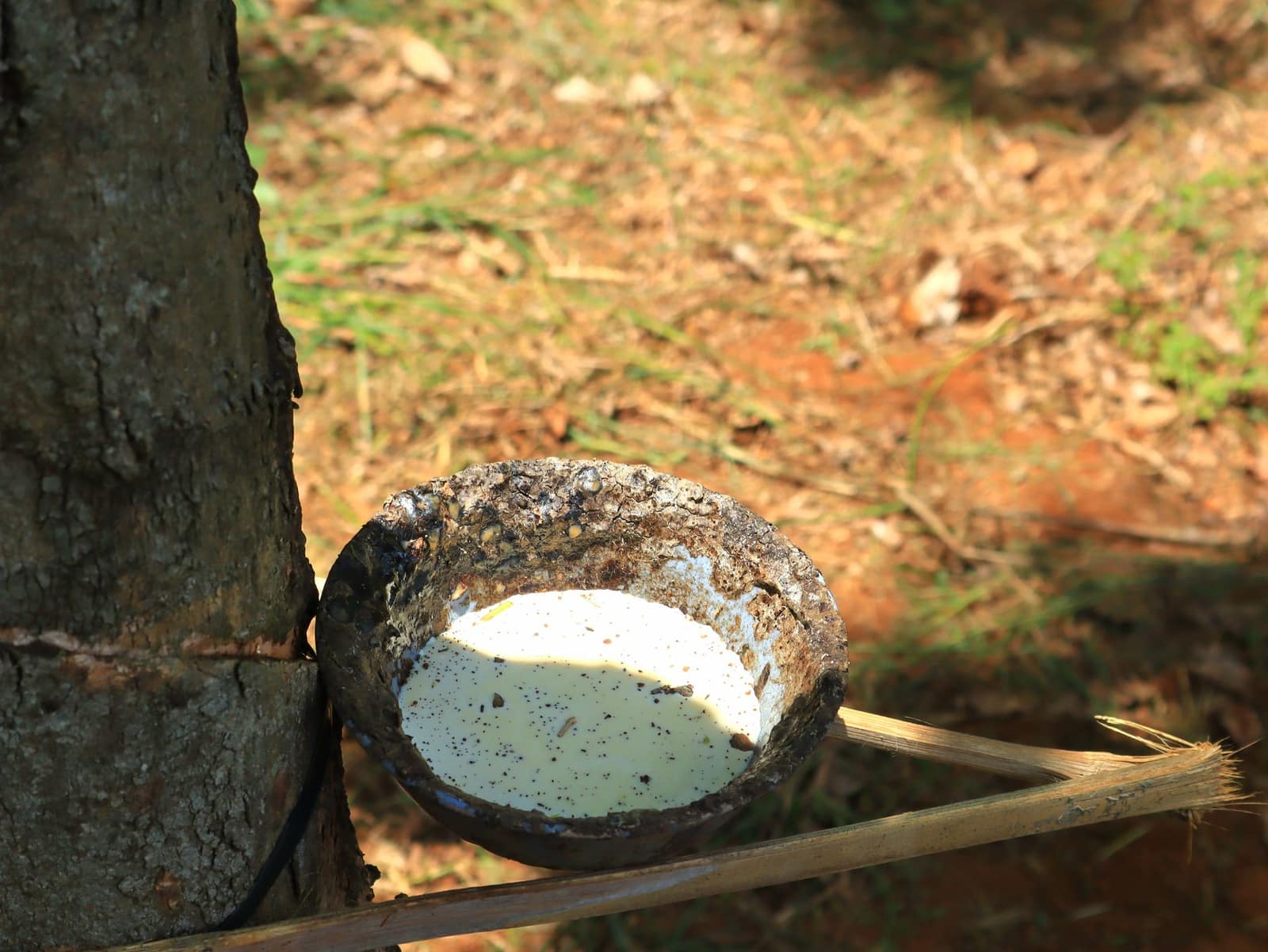
Farm produce
Export natural rubber
Sheet rubber, ISNR block rubber and latex from Kerala and Tripura. Rubber Board licence needed; exports follow world prices.
- HS code
- 4001 Natural rubber latex (4001 10), ribbed smoked sheets (4001 21), technically specified natural rubber such as ISNR (4001 22) and crepe and other forms (4001 29).
- Export policy
- Free to export Free under ITC(HS). Trading, processing and exporting rubber are governed by Rubber Board licensing; check the licence you need on the Rubber Board site and confirm the line on DGFT.
- Registrations
- 3 IEC, GST and those below
- India’s exports, 2025-26
- US$ 5.9 mn to 22 countries
What is exported
India is a large producer but also a large consumer of natural rubber; its tyre industry uses most of the crop and the country imports to fill the gap. Exports are smaller and opportunistic — they pick up when international prices are higher than domestic prices. Kerala grows most of India’s rubber, with Tripura and the other north-eastern states the fastest-growing areas.

Varieties, grades and forms
- Ribbed smoked sheets (RSS 1–5)Graded visually under the Green Book; RSS 4 and 5 are the most traded.
- ISNR block rubber (ISNR 5, 10, 20)Technically specified rubber in bales, tested in the lab; used by tyre makers.
- Centrifuged latex (60% DRC)For gloves, condoms, foam and dipped goods.
- Crepe rubberPale and estate brown crepe for footwear and adhesives.
Where it is grown or made
- KeralaKottayam, Pathanamthitta, Ernakulam, Idukki and Kollam — most of India’s production; Kochi port.
- Tripura and the North-EastTripura (second-largest state), Assam and Meghalaya.
- Karnataka and Tamil NaduDakshina Kannada and Kanyakumari.
The quality buyers ask for
- Sheet grades
- RSS 1X to RSS 5, graded visually under the international Green Book
- Block rubber
- ISNR 5, 10, 20 (and latex grades) by dirt content, ash, volatile matter, nitrogen, Po and PRI
- Latex concentrate
- About 60% dry rubber content, high or low ammonia, mechanical stability time to buyer spec
Certificates
- Rubber Board licenceRequiredLicence and returns required by the Rubber Board for dealing in and exporting rubber.
- ISNR quality certificateOften askedLab certificate showing the block rubber meets the ISNR grade.
- FSC / PEFC or EUDR due diligenceOften askedTraceability and deforestation-free evidence asked for by EU buyers.
- ISO 9001Often askedQuality management system; often asked for by industrial buyers.
Shipping, storage and shelf life
20-ft containers typically hold about 20 tonnes of baled sheet or block rubber; latex goes in drums, flexitanks or ISO tanks.
Sea freight from Kochi and Thoothukudi; Tripura rubber via Kolkata or through Bangladesh routes where permitted.
Dry, shaded and ventilated godowns; keep away from sunlight, copper and oils.
Dry rubber keeps well for a year or more if stored properly; latex must be used within months.
What goes on the pack and carton
- Each bale: grade, lot, producer or processor code, net weight and “Product of India”; ISNR bales carry the grade marking.
- Every carton or bag: product, grade, lot or batch number, net and gross weight, exporter name and “Made in India” / “Product of India”, matching the invoice and packing list.
The Rubber Board and its Rubber Research Institute of India (Kottayam) test and certify natural rubber; NABL-accredited polymer labs also test rubber (nabl-india.org).
Benefits of exporting this product
- RoDTEP: 1.3% of FOB
Tariff item 4001 21 00, 4001 22 00 and 4001 29 (smoked sheets, TSNR/ISNR and other natural rubber) earns 1.3% of FOB value, with no rupee cap, as a duty credit scrip on ICEGATE (Appendix 4R). Latex (4001 10 10 and 4001 10 20) earns 1.4%. Rates continue to 31 Dec 2026 (DGFT Notification 41/2026-27). Confirm your exact 8-digit line on DGFT before pricing an order.
DGFT — Appendix 4R, RoDTEP schedule for DTA exports w.e.f. 10 Oct 2024 (Notification 32/2024-25) ↗
Where to register
- Rubber BoardDealer, processor or exporter licence and returns as required by the Rubber Board; the Board is also the export promotion body for natural rubber under Appendix 2T.rubberboard.gov.in ↗
Quality and checks
- Grade certification to the Indian Standard Natural Rubber (ISNR) or Green Book sheet grades: dirt, ash, volatile matter, nitrogen and plasticity.
- Latex concentrate: dry rubber content (about 60%), ammonia level and mechanical stability.
- EU buyers ask for deforestation-free due-diligence data (plot geolocation) under the EU Deforestation Regulation; check its current application date.
Get the Rubber Board licence, then buy graded ISNR 20 or RSS 4 from a licensed processor in Kottayam or Agartala and offer one container when the international price is clearly above the Kottayam price. Watch the price gap daily on the Rubber Board site. Since 15 September 2026, a consignment worth up to ₹3 lakh FOB does not need an RCMC (DGFT Notification 36/2026-27). Registrations that a law requires for the product still apply.
Where new exporters go wrong
- Committing a forward sale and then losing money when the domestic price overtakes the export price.
- Mixed or wrongly graded sheets; buyers downgrade the whole lot.
- No plot-level traceability for EU buyers.
Documents this product needs
Schemes that apply
Sources (5)
- DGFT — ITC(HS) export policy search (Schedule 2)
- Rubber Board — official site (licences, grades, statistics)
- DGFT — Appendix 2T: Export Promotion Councils and the products under each
- DGFT — Appendix 4R, RoDTEP schedule for DTA exports w.e.f. 10 Oct 2024 (Notification 32/2024-25)
- Department of Commerce — TradeStat export data by commodity and country
Trade data
Indian natural rubber exports in numbers
From the Department of Commerce’s TradeStat, country by country. US$, Indian financial years (April–March).
- Exports in 2025-26
- US$ 5.9 mn -18.9% a year on average, 2020-21 to 2025-26
- Change from 2024-25
- ↓ -33.8% US$ 8.8 mn → US$ 5.9 mn
- Buyer countries
- 22
- Average export price
- US$ 1.94 per kg · 3,013 tonnes shipped · US$ 1.83 the year before
The price cycle
India’s average export price per kg each year (total value ÷ total quantity). Highest in 2021-22, lowest in 2020-21 — a 38% swing between them. Keep this swing in mind when you quote.
What next: a projection from the trend
The past trend carried forward — not a forecast by any authority. Sudden changes in policy, prices or demand are not in it.
Likely range US$ 2.7 mn to US$ 7.4 mn.
- Trend
- -12.3% a year
- Fit (R²)
- 0.41 — weak, read with care
- Based on
- 6 years of official figures
Method: a straight line through the logarithm of yearly exports (log-linear regression); range = ±1 standard error.
Biggest buyer countries
By value in 2025-26. Change is against 2024-25.
Where demand is rising and falling
Only countries that buy at least US$ 1 million or 1% of India’s exports of this product. Change from 2024-25 to 2025-26.
↑ High demand
No sizeable country falls in this list this year.
↓ Low demand
- Sri LankaUS$ 3.9 mn → US$ 1.7 mn↓-55.6%
New buyers: Countries that bought nothing from India in 2024-25 and did in 2025-26.
- Unspecified · US$ 500k
Which forms sell, and at what price
India’s exports by 8-digit tariff line, 2025-26. Average price = total value ÷ total quantity (TradeStat): the average of every shipment on that line, not the price of any one deal.
| Tariff line | Value 2025-26 | Change | Quantity | Average price |
|---|---|---|---|---|
Technically spcfd natrl rubr(tsnr)4001 22 00 · Rubber, technically specified natural rubber, in primary forms or in plates, sheets or strip | US$ 4 mn | ↑+2.9% | 1,955 tonnes | US$ 2.02 per kgwas US$ 1.93 |
Natrl rubr latex not prevulcanised4001 10 20 · Rubber, natural rubber latex, whether or not pre-vulcanised, in primary forms or in plates, sheets or strip | US$ 850k | ↓-71.9% | 543 tonnes | US$ 1.57 per kgwas US$ 1.61 |
Rubber, natural, in smoked sheets — natrl rubr in smkd sheets4001 21 00 | US$ 560k | ↓-48.6% | 240 tonnes | US$ 2.33 per kgwas US$ 2.25 |
Prevulcanised natrl rubr latex4001 10 10 · Rubber, natural rubber latex, whether or not pre-vulcanised, in primary forms or in plates, sheets or strip | US$ 360k | ↓-48.6% | 208 tonnes | US$ 1.73 per kgwas US$ 1.79 |
Balta gutta-percha etc. and smlr natrl gums4001 30 00 · Balata, gutta-percha, guayule, chicle and similar natural gums, in primary forms or in plates, sheets or strip | US$ 70k | ↓-22.2% | 45 tonnes | US$ 1.54 per kgwas US$ 1.71 |
Other natrl rubbr non-latex4001 29 90 · Rubber, natural, in primary forms or in plates, sheets or strip | US$ 40k | ↓-55.6% | 17 tonnes | US$ 2.39 per kgwas US$ 2.15 |
Natural rubber in pale crepe4001 29 20 · Rubber, natural, in primary forms or in plates, sheets or strip | US$ 10k | — | 2.0 tonnes | US$ 4.93 per kg |
The world market
Each country’s own recorded exports and imports in UN Comtrade, 2023 (the latest year nearly every country has reported).
- World imports
- US$ 14.1 bn 2023
- India among exporters
- #37 of 108 countries
- India’s share of world exports
- 0.1% US$ 6.7 mn
- Left for others to win
- US$ 12.3 bn exported by other countries
Top exporters — your competitors
- 1ThailandUS$ 3.65 bn 29.6%
- 2IndonesiaUS$ 2.48 bn 20.1%
- 3Côte d'IvoireUS$ 2.05 bn 16.6%
- 4Viet NamUS$ 848 mn 6.9%
- 5MalaysiaUS$ 814 mn 6.6%
- 6CambodiaUS$ 452 mn 3.7%
- 7Lao People's Dem. Rep.US$ 310 mn 2.5%
- 8BelgiumUS$ 247 mn 2%
- 9GuatemalaUS$ 176 mn 1.4%
- 10PhilippinesUS$ 125 mn 1%
Biggest buyers in the world
- 1ChinaUS$ 3.57 bn 25.3%
- 2USAUS$ 1.48 bn 10.5%
- 3MalaysiaUS$ 1.26 bn 8.9%
- 4Viet NamUS$ 1.18 bn 8.4%
- 5JapanUS$ 960 mn 6.8%
- 6IndiaUS$ 714 mn 5.1%
- 7Rep. of KoreaUS$ 412 mn 2.9%
- 8TürkiyeUS$ 394 mn 2.8%
- 9GermanyUS$ 391 mn 2.8%
- 10SpainUS$ 292 mn 2.1%
Opportunity: what these countries buy from the world, and from India
Each country’s own recorded imports in UN Comtrade, latest year it has reported. The long light part of each bar is demand other countries are filling today.
TradeStat’s 2023-24 quantities are double-counted, so that year is left out of the price. Sources: TradeStat — Export Import Data Bank, Department of Commerce · UN Comtrade database (United Nations Statistics Division) · Figures taken 29 October 2026.
Step by step
How to export natural rubber
Thailand, Indonesia, Vietnam, Côte d’Ivoire and Malaysia dominate world natural rubber exports. India ranks among the larger producers but consumes more than it grows, so it is a net importer and exports only when prices favour it. The tyre industry drives demand worldwide, and EU deforestation rules are pushing buyers towards traceable rubber. India’s smallholder plantations in Kerala and the North-East can offer traceability, which is an opening for niche exports.
- 01Get the licence
Obtain the Rubber Board licence and RCMC before trading for export.
- 02Watch the price gap
Compare the Kottayam price with international benchmarks daily; quote only when exports pay.
- 03Buy graded rubber
Buy from licensed processors with lab-certified ISNR or properly graded sheets.
- 04Inspect and pack
Get pre-shipment inspection and pack in standard bales or pallets.
- 05Book, stuff and file the shipping bill
Book the container, stuff it at the factory or a CFS, file the shipping bill on ICEGATE with the correct 8-digit code and the RoDTEP/RoSCTL declaration, and get the bill of lading.
- 06Get paid and close the file
Send the original documents through your bank (or to the buyer if paid in advance). Once the money arrives, get the e-BRC and claim RoDTEP, RoSCTL or drawback where they apply.
Questions
Questions about exporting natural rubber
Why does India export so little rubber?
Do I need a Rubber Board licence?
What is ISNR?
How does the EU deforestation rule affect me?
What RoDTEP applies?
Who buys Indian natural rubber
All countries → APTACNYBeijingChinaHuge market, but mostly for raw materials. Food plants must be registered with GACC; fresh produce needs a protocol.From India 2025-26US$ 19.5 bn
 CECAMYRKuala LumpurMalaysiaMulti-ethnic market with a large Indian-origin community. Halal expectations for food; CECA and AITIGA both apply.From India 2025-26US$ 6.83 bn
 EURBerlinGermanyEurope's largest economy and India's biggest EU partner. Values quality, certificates and supply-chain transparency.From India 2025-26US$ 11.5 bn
 USDWashington, D.C.United States of AmericaIndia's largest single-country export market. Strict FDA rules for food; extra 10% US duty on most goods since July 2026.From India 2025-26US$ 87.3 bn
More in farm produce
All products → Free, with conditionsFarm produceBasmati riceIndia’s top agri export by value. Free to export, but every contract must be registered with APEDA first.HS1006.30Exports 2025-26US$ 5.67 bn ↓4.6%
 Free, with conditionsFarm produceNon-basmati riceHigh-volume staple sold mainly to Africa and Bangladesh. Export reopened in 2024–25, but contracts must now be registered with APEDA.HS1006.30Exports 2025-26US$ 5.86 bn ↓10.2%
 Free to exportFarm produceSpicesWhole, ground and blended spices. Spices Board registration (CRES) is compulsory; residue and ethylene oxide tests keep buyers.HS0904–0910Exports 2025-26US$ 3.12 bn ↓5.1%
 Free to exportFarm produceChilliIndia’s largest spice export by volume. Dried red chilli goes to China, Thailand and Bangladesh; aflatoxin is the key test.HS0904.21Exports 2025-26US$ 1.1 bn ↓12.9%