


Other goods
Export furniture
Solid-wood, metal and cane furniture from Jodhpur, Saharanpur and other clusters; the USA buys the most.
- HS code
- 9401 Seats and chairs (9401) and other furniture — wooden, metal, cane, bamboo and plastic tables, beds, cabinets and their parts (9403).
- Export policy
- Free to export Free to export under ITC(HS) Schedule 2. Wood must come from legal sources; some species (such as red sanders) have their own export restrictions — check the DGFT ITC(HS) search for the timber you use.
- Registrations
- 4 IEC, GST and those below
- India’s exports, 2025-26
- US$ 1.46 bn to 169 countries
What is exported
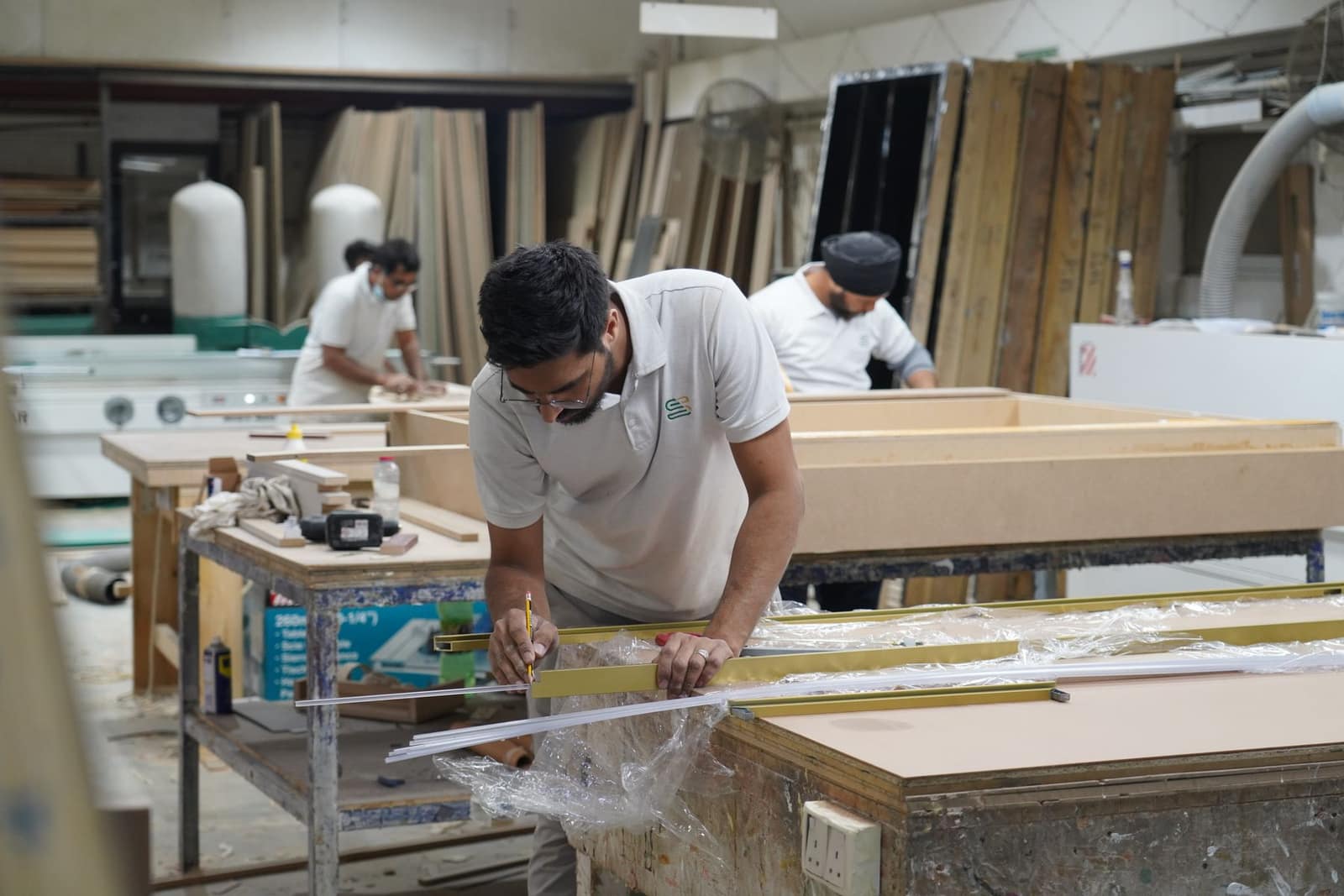
India exports solid-wood (mango, sheesham, acacia), metal, cane and mixed-material furniture, much of it handmade. Buyers are furniture importers, retail chains, online sellers and hotel projects. In 2025-26 India exported about US$ 1.1 billion under HS 9403 and about US$ 345 million under HS 9401; the USA led both, followed by Germany, the Netherlands, the UK, Spain and France for 9403.
Varieties, grades and forms
- Solid-wood furnitureMango, sheesham and acacia tables, cabinets and beds — the largest line (HS 9403 60).
- Metal and mixed-material furnitureIron, aluminium and wood-with-metal pieces in industrial styles.
- Chairs and seatingWooden and upholstered chairs, stools and benches (HS 9401).
- Cane, bamboo and rattan furnitureHandwoven pieces from the North-East, Kerala and West Bengal.
- Carved and inlaid furnitureSaharanpur carving, Hoshiarpur inlay, Sankheda lacquered furniture.
Where it is grown or made
- RajasthanJodhpur — the biggest solid-wood and metal furniture export cluster; also Jaipur
- Uttar PradeshSaharanpur (wood carving) and Moradabad (metal furniture)
- GujaratSankheda (lacquered furniture) and Ahmedabad
- Delhi NCR and PunjabKirti Nagar (Delhi) furniture market and NCR workshops; Hoshiarpur (inlay)
- Kerala and KarnatakaThrissur, Ernakulam and Mysuru — wood and cane furniture
The quality buyers ask for
- Moisture content
- Kiln-dried wood, commonly 8–12% moisture as specified by the buyer
- Strength and stability
- EN 12520/EN 12521 (seating and tables, EU) or ANSI/BIFMA (contract furniture, USA) where the buyer asks
- Formaldehyde
- Composite wood to US EPA TSCA Title VI limits (labelled) and E1 or stricter in Europe
- Finish
- Lead-free coatings; colour and sheen matched to the approved sample
- Dimensions
- Tolerance on size, flatness and joint gaps agreed with the buyer
Certificates
- Timber legality and EUDR due-diligence dataRequiredProof of legal harvest and, for the EU, geolocation of the forest plots.
- Lacey Act declaration (USA)RequiredFiled by the US importer using your species and origin data.
- ISPM 15RequiredWooden crates and pallets must be treated and stamped.
- FSC chain of custodyOften askedFor buyers selling certified wood furniture.
- Social audit (for example amfori BSCI, SMETA)Often askedRetail chains often ask for it before placing orders.
Shipping, storage and shelf life
Furniture fills a container by volume, not weight. A 40-ft high-cube is the usual choice; how many pieces fit depends on knock-down design and carton sizes.
Sea from Mundra, Pipavav or Nhava Sheva (Jodhpur and North India units often use ICDs such as Jodhpur, Moradabad or Delhi).
Keep finished goods dry and ventilated; fumigate or heat-treat packing wood.
What goes on the pack and carton
- Carton marks: item code, description, colour, quantity, gross and net weight, carton dimensions, "Made in India".
- USA: TSCA Title VI compliance label on products with composite wood.
- Assembly instructions and warnings (for example tip-over warnings for tall units in the USA).
IPIRTI (Bengaluru) tests plywood, panels and furniture; the Forest Research Institute (Dehradun) identifies wood species. Search NABL for labs accredited for furniture strength and formaldehyde tests.
Benefits of exporting this product
- RoDTEP: 0.7% of FOB
Tariff item 9403 60 00 (other wooden furniture) earns 0.7% of FOB value, with no rupee cap, as a duty credit scrip on ICEGATE. All 9403 lines carry 0.7%; seats under 9401 carry 0.5%, except upholstered and other seats under 9401 61 and 9401 69 at 0.7%. These rates continue to 31 Dec 2026 (DGFT Notification 41/2026-27). Confirm your exact 8-digit line on the DGFT RoDTEP page before you price an order.
DGFT — Appendix 4R, RoDTEP schedule for DTA exports w.e.f. 10.10.2024 (Notification 32/2024-25); rates continued to 31.12.2026 by Notification 41/2026-27 ↗ - Duty drawback: 1.2% of FOB
Drawback item 940399 (other furniture and parts) has an All Industry Rate of 1.2% of FOB, paid into your bank account. It is not available on exports under Advance Authorisation or from EOU/SEZ units. Seats (9401) also get 1.2%; furniture made mainly of marble (940301) gets 2.2%, capped at ₹236 per piece. Check the current schedule on the CBIC drawback page before shipping.
Gazette of India — Notification 77/2023-Customs (N.T.) dated 20.10.2023: All Industry Rates of duty drawback ↗ - Registered GI tags
Sankheda Furniture (Gujarat), Nirmal Furniture (Telangana), Chhatarpur Furniture (Madhya Pradesh) and Saharanpur Wood Craft (Uttar Pradesh) are registered Geographical Indications. Only registered producers and authorised users may sell under these names, which helps genuine makers stand out and fetch a better price.
IP India (Geographical Indications Registry) — Registration details of Geographical Indications ↗
Where to register
- EPCHHandcrafted wooden, metal and cane furniture is promoted by EPCH (wood ware and miscellaneous handicrafts); most furniture exporters take their RCMC here.epch.in ↗
- FIEOIf your factory-made furniture is not covered by a specific council, FIEO issues the RCMC.fieo.org ↗
Quality and checks
- USA: Lacey Act plant declaration naming the wood species and country of harvest; composite wood (MDF, particleboard, plywood) must meet EPA TSCA Title VI formaldehyde limits.
- EU: wooden furniture falls under the EU Deforestation Regulation (EUDR) — buyers will ask for plot-level geolocation of the timber. Confirm the current application date on the European Commission page.
- Moisture content of the wood (buyers commonly ask for kiln-dried wood) and fumigation or heat treatment of packing wood under ISPM 15.
- Stability, strength and finish tests (lead-free coatings for the USA) as per the buyer's standard.
Pick one material and style (for example mango-wood tables from Jodhpur) and work with a workshop that already exports. Prepare a photo catalogue with sizes and knock-down options, join EPCH, exhibit or visit the IHGF Delhi Fair, and start with a mixed container for one importer against an advance.
Where new exporters go wrong
- Wood that is not dried properly cracks or grows mould in the container — insist on moisture checks before packing.
- Shipping assembled furniture: freight per piece becomes too high. Design for knock-down packing where possible.
- No timber legality papers — EU and US buyers cannot import without them.
- US import duties on Indian goods have changed several times since 2025. Check the current rate for your code on the US tariff schedule and with your buyer before you quote.
Documents this product needs
Schemes that apply
- RoDTEP Remission of Duties and Taxes on Exported Products
- Drawback Duty Drawback (All Industry Rates)
- EPCG Export Promotion Capital Goods Scheme
- ECGC ECGC export credit insurance for small exporters
- LUT Letter of Undertaking for zero-rated exports under GST
- Districts as Export Hubs Districts as Export Hubs
Sources (10)
- Department of Commerce, Export Import Data Bank — India's exports of HS 9401 and 9403 by country, 2025-26
- DGFT — Appendix 2T: Export Promotion Councils and the products under each
- DGFT — ITC(HS) export policy search (Schedule 2)
- EPCH (Export Promotion Council for Handicrafts) — official site
- FIEO — Federation of Indian Export Organisations (RCMC for products without a specific council)
- USDA APHIS — Lacey Act plant declaration
- US EPA — Formaldehyde emission standards for composite wood products (TSCA Title VI)
- European Commission — Regulation on deforestation-free products (EUDR)
- IPPC — ISPM 15, Regulation of wood packaging material in international trade
- US International Trade Commission — Harmonized Tariff Schedule (current US duty rates)
Trade data
Indian furniture exports in numbers
From the Department of Commerce’s TradeStat, country by country. US$, Indian financial years (April–March).
- Exports in 2025-26
- US$ 1.46 bn +3.3% a year on average, 2020-21 to 2025-26
- Change from 2024-25
- ↓ -3.1% US$ 1.5 bn → US$ 1.46 bn
- Buyer countries
- 169
- Average export price
- US$ 9.45 per kg · 1,53,983 tonnes shipped · US$ 9.87 the year before
The price cycle
India’s average export price per kg each year (total value ÷ total quantity). Highest in 2020-21, lowest in 2025-26 — a 93% swing between them. Keep this swing in mind when you quote.
What next: a projection from the trend
The past trend carried forward — not a forecast by any authority. Sudden changes in policy, prices or demand are not in it.
Likely range US$ 1.32 bn to US$ 1.83 bn.
- Trend
- +1.5% a year
- Fit (R²)
- 0.08 — weak, read with care
- Based on
- 6 years of official figures
Method: a straight line through the logarithm of yearly exports (log-linear regression); range = ±1 standard error.
Biggest buyer countries
By value in 2025-26. Change is against 2024-25.
Where demand is rising and falling
Only countries that buy at least US$ 1 million or 1% of India’s exports of this product. Change from 2024-25 to 2025-26.
↑ High demand
↓ Low demand
- Saudi ArabiaUS$ 32.4 mn → US$ 24.3 mn↓-25.2%
- United States of AmericaUS$ 652 mn → US$ 570 mn↓-12.5%
- NetherlandsUS$ 105 mn → US$ 92.2 mn↓-12.3%
- CanadaUS$ 43.3 mn → US$ 38.2 mn↓-11.6%
Which forms sell, and at what price
India’s exports by 8-digit tariff line, 2025-26. Average price = total value ÷ total quantity (TradeStat): the average of every shipment on that line, not the price of any one deal.
| Tariff line | Value 2025-26 | Change | Quantity | Average price |
|---|---|---|---|---|
Furniture, wooden, other than for office, kitchen or bedroom use — other wooden furniture9403 60 00 | US$ 619 mn | ↓-10% | 8.5 mn pieces | US$ 72.71 per piecewas US$ 65.69 |
Others-of-other metal furniture :9403 20 90 · Furniture, metal, other than for office use | US$ 180 mn | ↓-13.1% | 43,401 tonnes | US$ 4.14 per kgwas US$ 4.36 |
Others-of-others-of-seats (other than those of heading 9402), whether or not convertible into beds, and parts thereof9401 99 00 · Seats, parts, for use in the assembly of motor vehicles as determined by the minister | US$ 159 mn | ↑+19.8% | 25,269 tonnes | US$ 6.27 per kgwas US$ 5.50 |
Others-of-others-of-other furniture and parts thereof9403 89 00 · Furniture, of cane, osier, or similar materials | US$ 88 mn | ↑+12.4% | 2.0 mn pieces | US$ 44.85 per piecewas US$ 48.43 |
Seats of a kind used for motor vehicles9401 20 00 · Seats, of a kind used for motor vehicles | US$ 58.7 mn | ↑+24.5% | 4.4 mn pieces | US$ 13.37 per piecewas US$ 27.21 |
Furniture, wooden, for office use — cabinetware9403 30 10 | US$ 49.6 mn | ↓-8.3% | 13,930 tonnes | US$ 3.56 per kgwas US$ 3.73 |
Upholstered seats with wooden frames9401 61 00 · Seats, with wooden frames, upholstered, | US$ 36.6 mn | ↑+2.9% | 428k pieces | US$ 85.43 per piecewas US$ 93.88 |
Furniture, metal, other than for office use — steel furniture9403 20 10 | US$ 32.2 mn | ↓-5.4% | 14,068 tonnes | US$ 2.29 per kgwas US$ 2.27 |
Others-of-others-of-other furniture and parts thereof9403 99 00 · Furniture, parts, of other than wood | US$ 30.8 mn | ↑+13.6% | 7,206 tonnes | US$ 4.28 per kgwas US$ 4.58 |
Other seats with wooden frames9401 69 00 · Seats, with wooden frames, not upholstered, | US$ 27.6 mn | ↓-25.1% | 757k pieces | US$ 36.48 per piecewas US$ 34.00 |
Other wooden furniture used in bedroom9403 50 90 · Furniture, wooden, for bedroom use | US$ 23.8 mn | ↓-2% | 292k pieces | US$ 81.51 per piecewas US$ 75.04 |
Furniture, parts, of wood — of wood9403 91 00 | US$ 22 mn | ↑+9% | 6,197 tonnes | US$ 3.56 per kgwas US$ 4.15 |
Seats of a kind used for aircraft9401 10 00 · Seats, of a kind used for aircraft | US$ 21 mn | ↑+214.5% | 140k pieces | US$ 150.75 per piecewas US$ 252.27 |
Furniture, metal, for office use — steel furniture9403 10 10 | US$ 18.8 mn | ↑+11.9% | 6,588 tonnes | US$ 2.86 per kgwas US$ 3.29 |
The world market
Each country’s own recorded exports and imports in UN Comtrade, 2023 (the latest year nearly every country has reported).
- World imports
- US$ 176.6 bn 2023
- India among exporters
- #22 of 164 countries
- India’s share of world exports
- 0.7% US$ 1.39 bn
- Left for others to win
- US$ 194.1 bn exported by other countries
Top exporters — your competitors
- 1ChinaUS$ 64.7 bn 33.1%
- 2PolandUS$ 14.4 bn 7.3%
- 3GermanyUS$ 13.7 bn 7%
- 4ItalyUS$ 12.7 bn 6.5%
- 5Viet NamUS$ 10.6 bn 5.4%
- 6MexicoUS$ 10.1 bn 5.2%
- 7USAUS$ 6.66 bn 3.4%
- 8CanadaUS$ 4.8 bn 2.5%
- 9CzechiaUS$ 4.66 bn 2.4%
- 10TürkiyeUS$ 4.07 bn 2.1%
Biggest buyers in the world
- 1USAUS$ 53.1 bn 30.1%
- 2GermanyUS$ 16 bn 9.1%
- 3FranceUS$ 9.24 bn 5.2%
- 4United KingdomUS$ 9.15 bn 5.2%
- 5CanadaUS$ 6.71 bn 3.8%
- 6JapanUS$ 5.49 bn 3.1%
- 7NetherlandsUS$ 5.45 bn 3.1%
- 8SpainUS$ 3.75 bn 2.1%
- 9CzechiaUS$ 3.65 bn 2.1%
- 10SwitzerlandUS$ 3.52 bn 2%
Opportunity: what these countries buy from the world, and from India
Each country’s own recorded imports in UN Comtrade, latest year it has reported. The long light part of each bar is demand other countries are filling today.
TradeStat’s 2023-24 quantities are double-counted, so that year is left out of the price. Sources: TradeStat — Export Import Data Bank, Department of Commerce · UN Comtrade database (United Nations Statistics Division) · Figures taken 29 October 2026.
Step by step
How to export furniture
China is by far the largest furniture exporter, followed by Vietnam, Poland, Italy and Germany; India is a smaller supplier best known for handmade solid-wood, metal and cane furniture. Demand is driven by home-furnishing retail and online sales in the USA and Europe, and by hotel projects in the Gulf. Buyers looking for a second source beyond China and Vietnam have opened doors for Indian makers. Openings are in solid-wood and mixed-material pieces with a craft look, knock-down designs that ship efficiently, and outdoor and hospitality furniture. Rules on timber legality (EUDR in Europe, the Lacey Act in the USA) now decide who can sell.
- 01Design for export
Adapt sizes to the market and design for knock-down packing.
- 02Source legal timber
Buy timber with transit permits and keep records of species and origin for EUDR and Lacey Act.
- 03Season and make
Kiln-dry the wood, then make, finish and quality-check each piece.
- 04Sample approval
Send samples or photos for approval of finish and dimensions.
- 05Pack and inspect
Pack with corner protection and silica gel; allow the buyer's inspection.
- 06Ship and claim benefits
File the shipping bill, claim RoDTEP and drawback, and send documents to the buyer's bank.
- 07Get paid
Advance plus balance against documents is common with importers.
Meet buyers
Trade fairs
- Twice a year: spring (February–March) and autumn (October) — check datesIHGF Delhi Fair (EPCH)Greater Noida, Indiaihgfdelhifair.in ↗
- April, every year — check datesSalone del Mobile.MilanoMilan, Italysalonemilano.it ↗
- April and October — check datesHigh Point MarketHigh Point, USAhighpointmarket.org ↗
- Check dates on the siteINDEX Dubai (interiors and furniture)Dubai, UAEindexexhibition.com ↗
- January and September — check datesMaison&ObjetParis, Francemaison-objet.com ↗
Questions
Questions about exporting furniture
Which council covers furniture?
What is EUDR and does it affect me?
Should I ship assembled or knock-down?
What RoDTEP and drawback apply?
Why do buyers ask for moisture readings?
Sources (9)
- EPCH (Export Promotion Council for Handicrafts) — official site
- FIEO — Federation of Indian Export Organisations (RCMC for products without a specific council)
- European Commission — Regulation on deforestation-free products (EUDR)
- USDA APHIS — Lacey Act plant declaration
- US EPA — Formaldehyde emission standards for composite wood products (TSCA Title VI)
- IPPC — ISPM 15, Regulation of wood packaging material in international trade
- Forest Stewardship Council (FSC)
- Indian Plywood Industries Research and Training Institute (IPIRTI), Bengaluru
- NABL — search for accredited testing laboratories
Who buys Indian furniture
All countries → USDWashington, D.C.United States of AmericaIndia's largest single-country export market. Strict FDA rules for food; extra 10% US duty on most goods since July 2026.From India 2025-26US$ 87.3 bn
 EURBerlinGermanyEurope's largest economy and India's biggest EU partner. Values quality, certificates and supply-chain transparency.From India 2025-26US$ 11.5 bn
 EURAmsterdamNetherlandsEurope's main gateway: Rotterdam handles goods for the whole EU. EU food-safety and residue rules apply.From India 2025-26US$ 17.5 bn
 CETAGBPLondonUnited KingdomNew CETA in force since July 2026 — most Indian goods now enter duty-free. Strong market for garments, food and engineering.From India 2025-26US$ 13.4 bn
 EURMadridSpainGrowing EU buyer of Indian garments, seafood, chemicals and auto parts; Valencia and Algeciras are key ports.From India 2025-26US$ 6.96 bn
 EURParisFranceFashion, food and design market. EU rules plus French-language labels; SIAL Paris is a key food fair.From India 2025-26US$ 7.1 bn
 CEPAAEDAbu DhabiUnited Arab EmiratesIndia's biggest Gulf buyer and a re-export hub for the Middle East and Africa. CEPA in force since 2022.From India 2025-26US$ 37.4 bn
 CADOttawaCanadaLarge Indian diaspora market. Importer needs a CFIA licence for food; labels in English and French.From India 2025-26US$ 4.67 bn
More in other goods
All products → Free to exportOther goodsCeramic and vitrified tilesMorbi-made wall, floor and vitrified tiles shipped by container; the UAE, Russia, USA and UK lead.HS6907Exports 2025-26US$ 2.12 bn ↓0.5%
 Free to exportOther goodsGranite and natural stonePolished granite slabs, monuments and sandstone from South India and Rajasthan; the USA leads.HS6802Exports 2025-26US$ 1.17 bn ↑0.7%
 Free to exportOther goodsToysWooden, plastic and board-game toys; child-safety testing decides access to the USA and EU.HS9503Exports 2025-26US$ 201 mn ↑18.5%
 Free to exportOther goodsPaper and paperboard packagingPaper bags, cartons and food packaging as plastic is phased out; the USA leads, then the UK and UAE.HS4819Exports 2025-26US$ 353 mn ↑6.1%